
The best palletizing solution depends on your production volume, budget, available space, and need for flexibility.
You can go with a fully engineered system, a cobot, or a plug-and-play setup. Each comes with tradeoffs. The key is picking what actually fits your floor, your throughput, and the return you expect.
This quick guide compares the most common palletizing solutions so you can make an informed decision and choose the right technology for your production floor.
- High-volume production → centralized palletizers
- Durable line automation → robotic palletizers
- Flexible operations → cobot palletizers
- Fast deployment → in-a-box palletizers
- Scalable growth → Robotiq Lean Palletizing
- Very low volume → manual palletizing
What are the main types of palletizing systems?
There are six common palletizing solutions used in manufacturing:
- Engineered centralized palletizers
- Engineered end-of-line robotic palletizers
- Engineered end-of-line cobot palletizers
- In-a-box palletizers
- Lean Palletizing workcells
- Manual palletizing
Each differs in throughput, cost, flexibility, and implementation complexity.
How do palletizing solutions compare?
Here is a simplified comparison of palletizing systems based on key decision criteria:
Key differences at a glance
- Highest throughput: Centralized palletizers (30–80 cases/min)
- Most durable: Robotic palletizers
- Most flexible: Cobot and Lean Palletizing
- Fastest to deploy: In-a-box palletizers
- Shortest ROI: Lean Palletizing (1–2 years)
- Lowest upfront cost: Manual palletizing (but highest long-term cost)
Which palletizing solution has the fastest ROI?
Robotiq Lean Palletizing workcells typically offer the fastest ROI, with a payback period of 1 to 2 years.
- Centralized systems: 4–7 years
- Robotic systems: long-term ROI
- Cobot systems: moderate ROI
- In-a-box systems: moderate ROI
- Manual palletizing: no true ROI due to ongoing labor costs
Which palletizing system is best for flexibility?
The most flexible palletizing options are:
- Cobot palletizers → easy redeployment, multiple SKUs
- Lean Palletizing → scalable across lines, adaptable workflows
These solutions are ideal for manufacturers with frequent product changes or growth plans.
Which palletizing system is best for high throughput?
For maximum output:
- Centralized palletizers: 30–80 cases per minute
- Robotic palletizers: 25–60 cases per minute
These systems are best suited for high-volume, stable production environments.
Which palletizing solution requires the least space?
- Smallest footprint: Lean Palletizing and in-a-box palletizers
- Largest footprint: Centralized and robotic palletizers
Lean Palletizing workcells typically require only 80-150 sq ft, making them ideal for space-constrained facilities.
Palletizing solutions comparison
Lean Palletizing offers the fastest ROI (1–2 years) and high flexibility, while centralized palletizers deliver the highest throughput but require higher investment and longer payback periods.
Download the comparative chart
How to choose the right palletizing system
To select the best palletizing solution, evaluate:
- Required throughput (cases per minute)
- Available floor space
- Budget and expected ROI
- Frequency of product changes
- Safety and ergonomics requirements
Final takeaway
There is no single “best” palletizing system.
- Choose performance → centralized or robotic
- Choose flexibility → cobot or Lean Palletizing
- Choose simplicity → in-a-box
- Choose entry-level → manual
For most growing manufacturers, Lean Palletizing provides the best balance of ROI, flexibility, and scalability. To see which Lean Palletizing model best fits your operations, try the Palletizing Fit Tool.
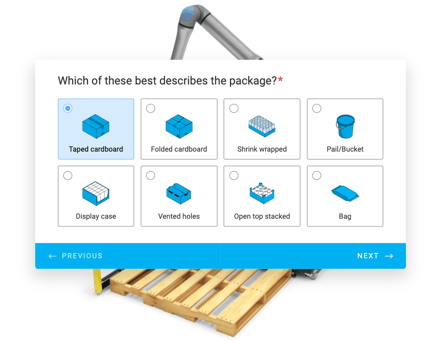
Get a clear answer instantly:
✔️ Check if your application is compatible
✔️ Estimate ROI based on your inputs
✔️ Get a recommended configuration
👉 Start your evaluation now with the Palletizing Fit Tool


The post “What is the best palletizing option for your operation?” by Marc Giguère was published on 05/05/2026 by blog.robotiq.com