
Last year in The Conversation Canada, we described Agrilo, an affordable “colorimetric” soil-testing system developed through research at MacEwan University. Using a smartphone camera to interpret colour changes, Agrilo measures soil nutrients and can provide farmers with timely guidance to support fertilizer decisions.
Our goal was to make practical soil information more accessible — so farmers could use fertilizer more efficiently, improve crop productivity and reduce unnecessary environmental impacts.
But affordability is only one part of successful agricultural innovation. For a technology to create value across different regions and farming conditions, users must also be able to learn its procedures confidently and apply them consistently.
So we developed Agrilo VR, a virtual reality training platform designed to support the wider adoption and standardized use of the soil-testing system.
Quality assurance on the farm
Agrilo uses a structured seven-stage testing protocol that guides users through soil preparation, reagent mixing, timing and colour measurement. As with laboratory and field-based analytical methods generally, following a consistent procedure helps ensure we can compare results reliably across users and locations.
This is especially important when testing is decentralized. Commercial laboratories achieve consistency through standardized procedures, trained personnel and controlled instruments. Agrilo is designed to bring similar principles of guided testing and quality assurance closer to the farm, allowing soil information to be generated where and when it is needed.
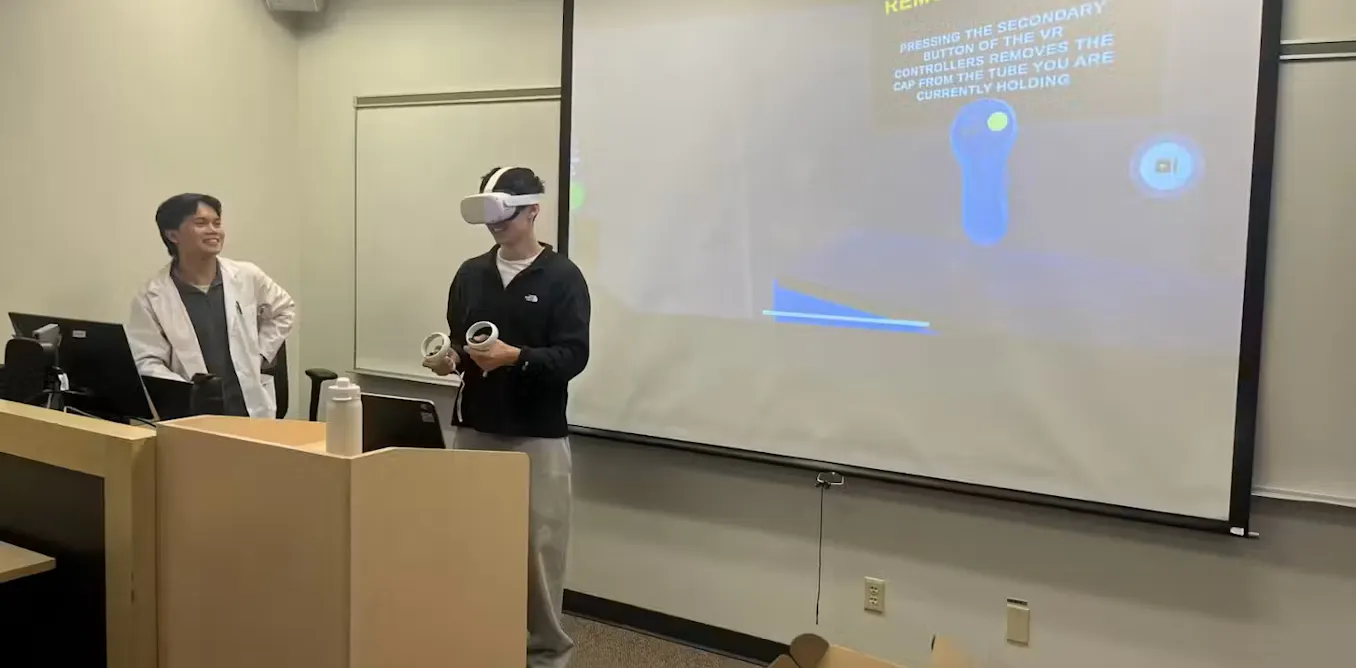
Agrilo VR allows farmers, students and field operators to practise the complete protocol before conducting a field test. The platform reinforces the sequence, timing and decision points within the procedure, helping users build confidence and consistency through repetition.
The Agrilo VR platform is an international collaboration between our team at MacEwan University and the research group led by Dr. Abel Méndez Porras at Tecnológico de Costa Rica’s San Carlos campus.
(PimaSens)
The barrier was never only cost
A 2025 survey of small farmers in Kentucky found that cost was the most-cited barrier to adopting the tools of precision agriculture.
Read more:
‘Agrivoltaics’ can both power AI data centres and increase food production — new study
However, complexity, doubts about profitability, privacy concerns, low confidence and time demands were also important. Only about one-quarter of respondents had adopted any precision tool.

(PimaSens)
A meta-analysis published in Precision Agriculture reached a similar conclusion: technical literacy and advisory support are among the strongest predictors of adoption.
Reducing the cost of soil testing to approximately $10 can make routine testing considerably more accessible. Combining affordability with structured training, standardized procedures and ongoing user support can address several additional barriers to adoption at the same time.
The benefits of virtual training
Agrilo VR runs on a Meta Quest headset and guides trainees through the soil-testing protocol in the correct sequence. Each stage must be completed before the trainee advances, reinforcing the same structured workflow used in the Agrilo system.
A custom liquid simulation shows reagent mixing and colour development as they would appear on a workbench. This is particularly valuable for colorimetric analysis, where recognizing the timing and appearance of a reaction is part of developing practical proficiency.
With users’ consent, the platform’s cloud-based component can collect aggregated training data showing where users request additional guidance or repeat an activity. These data can help educators identify training needs while allowing the team to continuously improve both the learning experience and the supporting protocol.
Virtual training also provides a resource-efficient environment for practice. Trainees can repeat the procedure as often as necessary without consuming materials.

(PimaSens)
A further benefit is standardization. The platform is being evaluated and demonstrated across locations that include KwaZulu-Natal in South Africa, Medicine Hat in Alberta, Costa Rica’s San Carlos and Nairobi. This helps support consistent testing practices and more reliable comparison of results across sites.
What can simulation contribute?
Simulation has a long record in procedural training, including aviation, health care and technical education. Research in these fields suggests that well-designed simulation can support knowledge development, procedural confidence and repeated practice.

(PimaSens)
We do not claim that virtual training is universally superior to conventional instruction. Its biggest advantage is scalability: the platform can deliver the same structured learning experience across multiple locations while reducing the need to send an experienced trainer to every site.
Our next step is to evaluate how effectively this approach supports learning, user confidence and consistent performance when trainees move from the virtual environment to soil testing in the field.
Virtual training, field experience
As co-founders of the company developing Agrilo, we recognize the importance of evaluating the technology transparently — distinguishing demonstrated benefits from those that require further study.
Research on virtual reality in agricultural training is growing, although the evidence base remains less developed than in fields such as aviation and health care. This creates an important opportunity to evaluate how virtual practice contributes to user confidence, procedural consistency and performance under field conditions.
Agrilo VR is designed to complement, rather than replace, practical field experience. Virtual training can introduce the testing sequence, reinforce key decisions and allow users to repeat procedures in a controlled setting. Field experience then adds the realities of local soils, weather, lighting, cropping systems and other environmental conditions.
Combining these approaches may offer the strongest training model: users first develop familiarity and confidence through structured simulation and then apply and refine those skills in real agricultural settings.
Building the capacity to adopt agricultural technology
Canada’s productivity challenge is partly a technology adoption challenge. Developing a useful and affordable tool is essential, but successful adoption also depends on whether people can understand it, trust it and integrate it confidently into their work.
Agrilo was developed to make actionable soil information more accessible. Agrilo VR extends that objective by creating a scalable way to introduce the procedure, reinforce consistent practices and prepare users for field application.
Through our collaboration with Dr. Porras and his research group, we are exploring a broader model for agricultural innovation: combine affordable diagnostics with accessible training, field experience and continuous improvement.
The instrument and the user should not be viewed separately. When affordable technology is supported by well-designed training, farmers and field operators are better positioned to generate useful information and translate it into informed agricultural decisions.
The post “We built a $10 soil test, then a virtual reality platform to take it around the world” by Mohammed Elmorsy, Associate Professor, Department of Computer Science, MacEwan University was published on 08/12/2026 by theconversation.com