
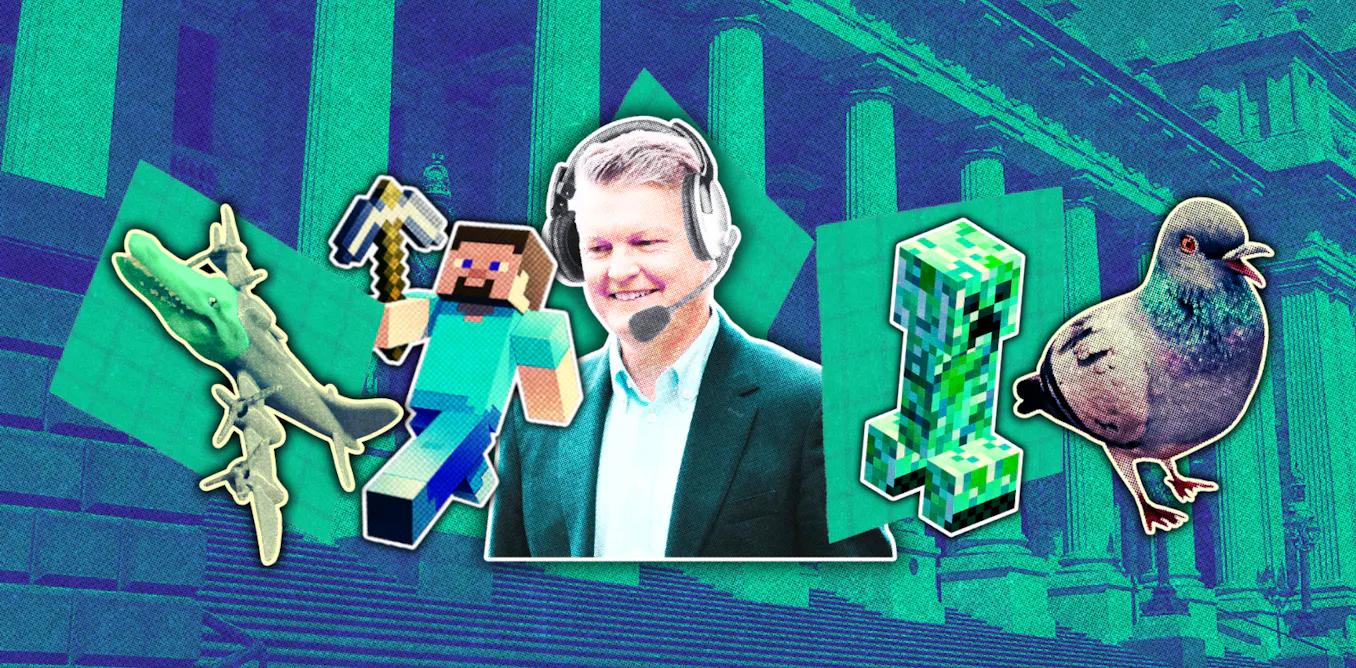
What do Minecraft, brainrot and techno raves have in common? They have all been co-opted as political campaign strategies.
With Victoria heading to the polls later this month, Victorian Labor has ventured into Minecraft, the video game where people build worlds out of blocks.
As a reward for reaching 35,000 followers on Minecraft, Labor hosted a virtual party on TikTok featuring a Pauline Hanson diss track in phonk (a sub-genre of hip hop) style. Premier Ben Carroll even appeared to DJ on the TikTok live stream, though his button-pressing didn’t always seem to match the music.
The event peaked at around 600 participants, with average attendance closer to 200.
Which raises an obvious question: who exactly was this for?
Were young voters suddenly inspired to investigate Labor’s policies? Was it aimed at younger children whose parents might be potential Labor voters? Or was the real audience everyone watching clips of a politician pretending to DJ in a block-shaped universe?
Welcome to modern political campaigning, where winning the algorithm can sometimes seem more important than winning an argument.
From Italian brainrot to political brainrot
This is not the first time we have seen a trend-driven campaign. Labor famously used TikTok in its winning 2022 federal election campaign.
And, during Australia’s 2025 federal election, the Liberal Party introduced voters to Tim Cheese, an AI-generated mouse complaining about the cost of living. There were diss tracks, gaming memes and deliberately chaotic videos, presumably designed to speak the language of a younger audience.
This is the world of brainrot: nonsensical, overstimulating internet content featuring everything from AI-generated animals to surreal characters speaking in strange voices.
Italian brainrot involves bizarre AI-generated creatures with pseudo-Italian names, such as a crocodile crossed with a fighter jet named Bombardino Crocodilo. But add a political message and it gets very odd.
The logic is understandable. Young people spend considerable time consuming short-form entertainment, so political parties want to appear in those feeds.
But there’s a fine line between understanding internet culture and looking like someone’s dad attempting a TikTok dance at Christmas.
Germany’s election gets even stranger
If Australia’s experiments seem unusual, Germany’s 2025 federal election provides some competition.
A youth political group affiliated with the left-wing party Die Linke turned speeches by veteran politician Gregor Gysi into techno remixes, creating the unlikely phenomenon of DJ Gysi.
Die Linke subsequently won 25% of the vote among 18–24-year-olds. Whether the techno helped is not clear.
On the other side of politics, the Alternative for Germany (AfD) Brandenberg branch posted a fully AI-generated advertisement depicting the future of Germany. This video included AI versions of rival party leaders Karl Lauterbach (Social Democratic Party) and Robert Habeck (Greens).
And AI-generated influencers have begun spruiking political messages. This includes Larissa Wagner, who is believed to have been created by a far-right group with connections to the American online magazine Compact.
A TikTok creator also used the absurdist trend of talking AI animals to question the apparent contradiction between AfD leader Alice Weidel’s personal life and her party’s policies.
It’s political commentary delivered by a pigeon in a bathroom. And somehow, that makes perfect sense on TikTok.
German academic Marcus Bösch argues brainrot isn’t simply meaningless entertainment. Its absurdity can make political messages easier to circulate, often disguised through humour and irony.
It’s a little like hiding the vegetables in a toddler’s dinner, except the vegetables are political ideology and the dinner is an AI-generated pigeon.
The danger is that repeated exposure can make even troubling political imagery appear familiar, without anyone necessarily engaging with the ideas behind it.
Politics has entered the rave
Britain’s Greens party has taken the word “party” literally, moving political campaigning onto actual dance floors.
Since January, a grassroots collective called Green Space, created by Greens members, has been organising political raves, complete with DJs, dancefloors and appearances from party leader Zack Polanski.
Its first London event attracted around 1,400 revellers and raised £13,000 (A$25,000), while a subsequent Leeds rave drew more than 2,000 and is estimated to have raised £16,000 (A$31,000). That is considerably more tangible than a few thousand video views.
It also highlights an important distinction. A nightclub fundraiser can create community, recruit volunteers and generate money, particularly in a world where we are craving real connection, both face-to-face and virtually.
When the meme becomes the message
Political parties are increasingly trying to inhabit a world, described by journalist and social commentator Kieran Press-Reynolds as “Shitpostmodernism”. It is an internet of fragmented trends, absurd humour and rapidly changing cultural references.
Of course, there’s nothing wrong with politicians having fun. Humour can make politics more accessible, while engaging with online culture can reach people who would never attend a traditional political event.
But visibility, engagement and influence are very different things. Someone might share a politician’s Minecraft performance because they love it, hate it, or simply cannot believe it’s happening. None necessarily translates into a vote.
Perhaps Victorian Labor’s Minecraft party introduced politics to an entirely new audience. Or perhaps 200 people just enjoyed some phonk while a politician enthusiastically pressed buttons.
Either way, the question remains: are politicians getting better at communicating with young people, or just getting better at entertaining them?
The post “Minecraft, techno raves and brainrot are modern election strategies, but do they win any votes?” by Susan Grantham, Senior Lecturer in Communication, Griffith University was published on 11/16/2026 by theconversation.com