
Students across Canada are exposed to artificial intelligence (AI) whether through search engines, writing assistants, automated recommendation systems or social media.
That everyday exposure raises a first, fundamental question: What should students should learn about AI? This goal is often described as AI literacy, which combines conceptual understanding with responsible use and critical judgment about AI.
A second, more practical, question is: Where should learning about AI sit in the curriculum? Since education is a provincial responsibility, Canada has no single approach.
Teaching AI literacy in schools builds on what provinces already require students to learn about digital technologies. How provinces do this determines how much time students get, what can be assessed and how teachers must be prepared.
In practice, these different curriculum models, plus the supports to ensure teachers can effectively teach them, will shape whether AI education becomes a set of tips for using apps — or a form of digital citizenship grounded in concepts, ethics and critical thinking.
What AI literacy implies for schools
Several provinces and educator associations have or are developing frameworks pertaining to AI in K-12 education. Several organizations have proposed similar frameworks that specify the concepts and competencies students should develop, or that guide what meaningful AI education would require in schools.
The United Nations Educational Scientific and Cultural Organization sees AI literacy spanning technical understanding and ethical awareness, and names a vision of students as AI co-creators and responsible citizens.
A U.S.-based framework, AI4K12, outlines what students should learn about AI across grade levels, and identifies five “big ideas” about AI: perception, representation and reasoning, learning, natural interaction and societal impact.
(Allison Shelley/The Verbatim Agency/EDUimages), CC BY-NC
The U.S.-based International Society for Technology in Education (ISTE) proposes standards that engage students as empowered learners, computational thinkers, innovative designers and digital citizens.
Digital learning in provincial curricula
Across Canada, provinces integrate digital learning through different models — but note that these models are ideal types. Several provinces combine them. Each model can support AI literacy, but each creates different conditions for time, assessment and teacher preparation.
1. A dedicated subject or domain, where digital skills or computer science have their own courses. In many systems, teachers have been specifically trained for the subject. This configuration typically supports clearer sequencing across grades and more consistent assessment.
For example, between kindergarten to Grade 9, British Columbia teaches technological learning within applied design, skills and technologies curriculum, with Grade 8 requiring the equivalent of a full-year course that schools can deliver through modules.
Newfoundland and Labrador frames technology education as a hands-on area that can include programming and controlling physical devices through two dedicated courses about computer science in Grades 9 and 10.
Ontario’s computer studies curriculum creates dedicated course space for learning computing concepts. Ontario also illustrates how systems can shift emphasis over time: coding and digital competencies can be embedded within compulsory subjects, while a separate computer studies curriculum expands opportunities for sustained progression.
A dedicated subject provides protected classroom time to teach related core ideas (for example, data, algorithms and modelling) and to assess learning beyond using tools, while still making possible cross-curriculum learning.
It also creates clearer conditions for implementing ambitious AI literacy frameworks such as AIK12 and UNESCO’s guidance. This is because a teacher trained to translate specialized concepts for non-specialists leads instruction and can support sustained, project-based learning.
However, in many provinces, this “dedicated subject” exposure remains intermittent across K–12, often concentrated in a small number of courses, or sometimes a single year-long course with limited weekly time. This constrains cumulative progression and makes outcomes sensitive to local staffing capacity and teacher qualification.
2. Digital learning embedded in existing subjects. In New Brunswick, digital learning in Grades 6 to 8 is organized through the Middle Block, where Technology is one learning area among others. Teachers must address digital learning alongside a much wider set of practical and developmental goals, rather than teaching it as a fully separate subject with protected time.

(Allison Shelley/The Verbatim Agency/ EDUimages), CC BY-NC
This approach can make learning more connected to real problems and other learning. But it can also limit how much time can be devoted to AI-related concepts, and whether this learning is effective, when many other objectives must be covered within the same program structure. The trade-off is generally capacity: teachers are asked to carry new conceptual content without necessarily having time, training or materials.
3. A “transversal” framework, where competencies that underpin digital technology are meant to be integrated across subjects.
For example, Manitoba teaches literacy with information communication technology (ICT) across curriculum, related to thinking critically and creatively about information and about communication, “as citizens of the global community, while using ICT safely, responsibly and ethically.” Alberta’s information and communication technology program of studies states that it is “not intended to stand alone” but should be infused within core courses.
Québec has a province-wide digital competency framework describing 12 dimensions of confident, critical and creative uses of digital technology.
When competencies related to digital learning are integrated across subjects, every student can be reached, not only those who choose electives.
However, without clear accountability tying underlying competencies to particular digital media uses, this approach can potentially yield uneven learning experiences from school to school. Every teacher must also receive sufficient professional development on the subject.
What ‘AI-ready’ could mean
Each model requires different policy supports. Dedicated subjects need staffing and teacher preparation pipelines. Embedded approaches need sustained professional learning and realistic expectations for non-specialist teachers. Transversal frameworks need clear markers for student progression and assessment strategies, otherwise implementation depends on local enthusiasm.
For many provinces, the path forward is likely not choosing one model, but combining the strengths of all three.
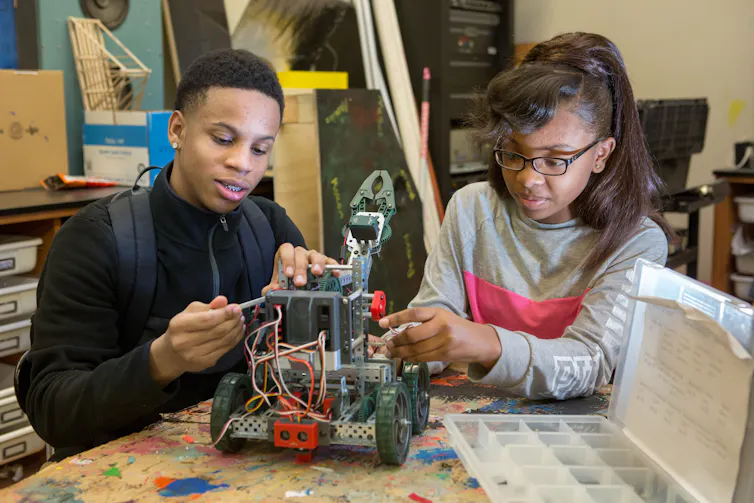
(Allison Shelley/The Verbatim Agency/EDUimages), CC BY-NC
This requires grounding in foundational knowledge of AI, as well as developing both discipline-specific and transdisciplinary competencies. UNESCO’s AI competency framework for teachers makes a similar point: governments should anchor AI learning in curriculum policy, build collaboratively with educators and invest in teacher preparation and resources.
Canada’s provincial diversity creates conditions for comparative analysis. If researchers study student learning associated with different models, this could help identify which policy arrangements, supports and implementation strategies are associated with stronger and more equitable forms of AI education.
Comparison may become even more salient with the OECD’s planned PISA 2029 media and artificial intelligence literacy assessment, which will be designed to examine whether students have had opportunities to learn to engage critically and responsibly with digital and AI systems.

The post “How should schools teach AI? 3 models to consider” by Hugo G. Lapierre, Professeur adjoint en technologies éducatives, Université de Montréal was published on 05/03/2026 by theconversation.com