
People often take their muscles for granted. They pick up a bag, tighten a grip, climb a hill, hold a cup of coffee and the body quietly adjusts force, speed and position without the person ever thinking about it.
Muscle turns chemical energy into movement. It is able to produce force smoothly and reliably, even though it is built from huge numbers of tiny molecular components. When the load changes, muscles don’t simply wobble or fail. They adapt.
But the way that muscle works on a molecular level isn’t a settled issue. With colleagues, our team at the University of Bristol built a physical model using ordinary electric motors to try and simulate how muscles may perform its tasks.
The results, published in the Royal Society journal Interface, show that the coordination we see in real muscle may simply emerge as a property of their setup. It’s not something you have to programme and police continuously. The findings could even help improve the way that robots function.
If we were to zoom inside a muscle, we would find bundles of smaller and smaller structures. The sarcomere is the key force producing unit. It is made of protein filaments, called actin, and molecular motors called myosin. Together, they form the actomyosin system.
Tiny myosin motors repeatedly grab, pull and release actin cables, helping muscle fibres contract. When you hold a cup of tea, thousands of these motors have to work together to produce a steady force. But there are unanswered questions about this system.
We first devised a mathematical model of muscle. Real muscle motors (myosin) run on a complex chemical cycle, but we didn’t try to reproduce that chemistry. Instead, we represented each force producing unit as something much simpler: a cycling “rotor” (or motor) that can contribute only when it is mechanically engaged to a physical “backbone”. When it is disengaged, it effectively drops out, and becomes isolated from the rest.
To test whether we could translate these ideas to a real physical system, we built a tabletop device: a line of simple electric motors interacting through a shared mechanical backbone. They pulled against a thick fluid, creating resistance similar to the viscous load experienced by biological motors inside muscle.
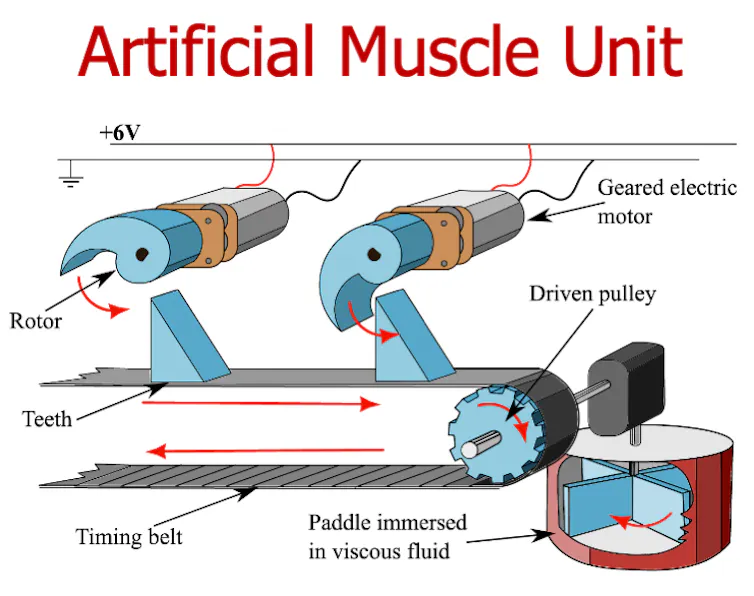
Our physical model produces force when supplied with current. We wanted to see whether, when many driving units were embedded in the right kind of mechanical setting, could the setting organise into coordinated muscle-like behaviour?
In both the mathematical model and the device, the motors don’t stay connected all the time. Instead, each motor briefly makes contact with a shared moving backbone, pushes on it, then lets go. As the backbone moves, it carries the mechanical effects of one motor to the next, allowing them to coordinate without ever communicating directly.
When they are not connected, each motor acts on its own. That single design choice makes the whole network of motors reorganise itself over time – much like biological motors do inside muscle, where motors attach and detach as part of their biochemical cycles.
In practical terms, the scaffold where the rotors live is doing a lot of the coordinating work, but it is hidden. It mediates how units can “feel” one another strongly enough for collective patterns to form.
Even in this stripped-down system, several muscle-like forms of behaviour spontaneously appear. As resistance increases, the motors collectively develop a load-speed relationship. Load refers to the mechanical tension and physical stress placed on the system.
More units end up contributing effectively as the load rises. Their participation increases under increasing loads. We also found that under certain conditions, motion can become jerky. For example, periods of coordinated pulling were interrupted by sudden slips. This echoes patterns seen in real actomyosin experiments.
Instead of everything working in unison, the system can self-organise into travelling waves of coordination, where the pattern moves along the array.
In a loose way, this “scales up” the core idea behind a sarcomere: many force units embedded in a shared structure that transmits forces from one unit to the next, allowing coordination to emerge spontaneously.
Coordinating without a conductor
Muscle isn’t the only place where nature has solved the problem of coordinating many tiny motors. Microscopic flagella are tail-like appendages seen on the cells of some eukaryotes – the group of organisms that includes animals and plants.
Examples of these flagella include the tail on human sperm. Cilia are microscopic, hair-like structures on many eukaryotic cells. Both flagella and cilia are powered by large numbers of molecular motors distributed along a long, slender scaffold.
Their internal core – the axoneme – is a beautifully organised structure that transmits forces along its length and turns local motor activity into bending waves. Those waves are essential: in sperm they underpin motility and fertility, and in cilia they help move fluids in the airways and other tissues, with clear links to health and disease.
In that sense, flagella are “muscle-like” systems in disguise. You again have drivers (motors that generate force) embedded in a coupling structure (a mechanical scaffold that transmits force and feedback). And the geometry determines how local activity adds up to a coherent, travelling wave.
Read more:
The way a sperm tail moves can be explained by mathematics worked out by Alan Turing
If the structure and layout are doing some of the organising work, it speaks to a question that has long intrigued scientists: how evolution builds systems made up of a large number of individual motors that nevertheless coordinate themselves, remain reliable and adapt to changing conditions without a central control system?
Uses in robotics
Our results matter beyond biology. In robotics, getting many actuators (the “muscles” of a robot, which convert an energy source like electricity into motion) to cooperate is challenging and expensive. You add sensors, feedback loops, control algorithms, sometimes even mechanical ratchets or complex gearing to keep everything stable under loads. It works, but it can be fragile and prone to errors.
Our physical model of muscle, where coordination emerges as a property of the setup, suggests that simpler actuators for robotics are possible. This is exactly the kind of fundamental design that researchers have been chasing for soft robots (which use flexible materials) and artificial muscles for robotics.
Muscle may be an example of coordination without a conductor. Thousands of molecular motors working together, not because each one is individually controlled, but because the soft structure around them helps guide their collective behaviour.
Our findings suggest that robotics could begin to harness the same principle. In future, this could help bring robotics closer to biology, opening the way to more organic machines, whose bodies help shape how they move and adapt.
The post “Muscle coordination can be mimicked by electric motors – it could lead to improved robots” by Hermes Bloomfield-Gadêlha, Mathematician, University of Bristol was published on 07/30/2026 by theconversation.com