
Our novel artificial intelligence model can predict extreme storm surges with high accuracy, including under future climate conditions. Because the AI model runs much faster, it can help researchers and practitioners better assess coastal flood risk for adaptation planning.
Sea levels are rising, and with them, the risks posed by extreme coastal events, such as storm surges – temporary rises in sea level caused mainly by storms, which are among the primary drivers of coastal flooding. For the more than 10% of the global population living in low-lying coastal regions, the combination of gradual mean sea level rise and increasingly intense extreme events represents a growing threat.
For coastal planners and policymakers, the key issue is not just the expected rise in mean sea level, but the changes in the likelihood and severity of extreme events. Infrastructure design, urban planning and disaster preparedness depend on estimates of extreme event scenarios.
However, projecting extreme sea level events remains a major scientific challenge, as they are driven by complex, nonlinear interactions between tides, atmospheric forcings, ocean dynamics and local coastal features. This means that uncertainty in extreme projections remains highly unquantified. Small differences in model assumptions can lead to large differences in predicted outcomes, especially for extremes. This uncertainty means a lot for planners, civil protection and, ultimately, the protection of human lives and assets.
The efficiency of AI models opens up new possibilities. Because AI models can generate predictions much faster than physics-based models, they enable the exploration of large ensembles of future scenarios, which would be prohibitively expensive using traditional models alone. This is particularly important for risk assessment, where understanding the probability of rare but catastrophic outcomes is essential.
A combined AI and physics-based approach for a changing risk
Traditional physics-based models, which use physical laws to represent how coastal waters move, can simulate these processes in detail, but they are computationally expensive, making it difficult to explore a wide range of future scenarios and uncertainties.
At the same time, artificial intelligence (AI) is increasingly being used in climate science, as it offers new opportunities to overcome these challenges. However, its reliability remains uncertain in this context, particularly due to two key challenges: the limited representation of rare but high-impact extremes in training data, and the need to generalise findings – in a robust fashion – to future climate conditions that may differ substantially from those observed historically.
AI and physics-based modelling are complementary tools: physics-based models remain essential for representing the underlying processes and for generating the high-quality data needed to train and validate AI models, and ultimately to build trust in their AI counterpart.
By combining the physical realism of traditional models with the efficiency and flexibility of AI, researchers are developing a new generation of tools for coastal risk assessment. These tools will be critical for informing adaptation strategies, helping societies better prepare for a future where extreme sea level events might become more frequent and more severe.
Our findings suggest that AI can be reliably used for projecting rare but high-impact extreme sea level events. In addition, AI models, by enabling rapid scenario generation and sensitivity testing, provide a new tool to better characterise these uncertainties.
A new AI emulator for extreme storm surge prediction
In our recent study published in Earth’s Future, we investigated whether AI-based models can accurately predict extreme sea level events, when trained to emulate the outputs of physics-based simulations and projections. In other words, our AI models aim to learn to reproduce the results of these more complex models, but much faster.
Our results show that AI emulators can successfully learn the complex dynamics behind storm surge events and reproduce extremes with high accuracy, including under future scenarios, compared to available projections up to the mid-21st century.
To demonstrate this, we developed a framework to improve the ability of AI models to represent extreme storm surge events and to test whether their predictions remain reliable under future scenarios.
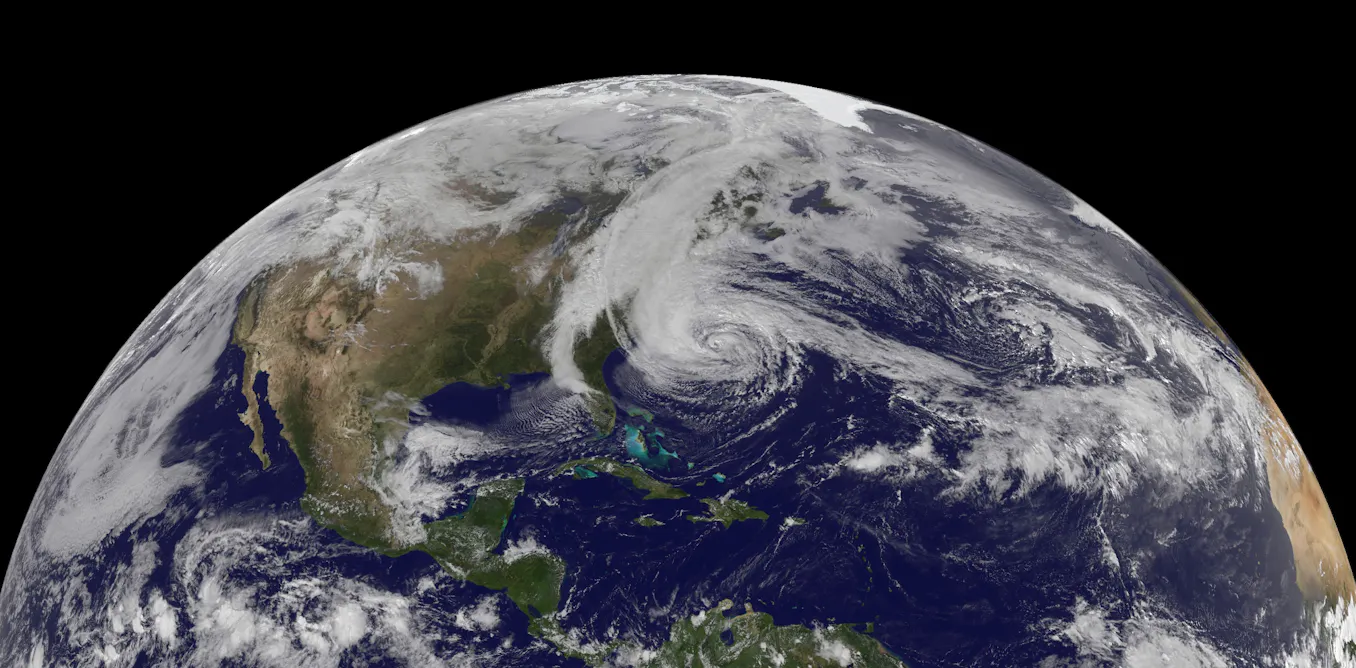
We focused on the New York City coastal area as a case study, because it is highly exposed to coastal flooding, presenting a dense population, critical infrastructure and major economic assets – and because it has experienced devastating storm surges in recent history, such as during Hurricane Sandy in 2012, which caused many fatalities and over $60 billion in economic damage.
Our AI emulator relies on openly available physics-based simulations from the Global Tide and Surge Model (GTSM), not only for training, but also for assessing its reliability under different climate conditions, including future scenarios.
Adapted from Longo et al., 2026.
Current limitations and next steps
The next step is to test the robustness of such AI tools further across a wider range of climate scenarios and integrate them into operational risk assessment frameworks and global climate data services providing hydro-climatic and coastal information to decision-makers, such as the Aqueduct Flood Risk Analyzer and the Copernicus Climate Data Store.
More broadly, AI models have the potential to address several critical needs in coastal risk analysis, but important gaps remain. These include improving and rigorously quantifying their transferability across a wide range of future scenarios, better representing uncertainties associated with physics-based parameters embedded in the training data, and assessing how well these models generalise across different geographic locations.
Clarifying the limits of their extrapolation capabilities will be essential for building confidence in their use for decision-making, particularly under conditions not seen before, due to climate change and non-stationarities (that is, changes in climate regimes and more intense extremes than what was observed before), and that are therefore outside the range covered by past observations or physics-based simulations used to train the AI models.

The AXA science philanthropy is now part of the AXA Foundation for Human Progress, which brings together the commitments of AXA Group and Mutuelles d’Assurances in the fields of Science, Nature, Solidarity, and Culture. Before 2025, the global science philanthropy was held by the AXA Research Fund, which has supported over 750 projects around the world since its inception back in 2007. To learn more, visit Axa Foundation for Human Progress.

A weekly e-mail in English featuring expertise from scholars and researchers. It provides an introduction to the diversity of research coming out of the continent and considers some of the key issues facing European countries. Get the newsletter!
The post “Can AI help coastal cities prepare for rising seas and extreme events?” by Andrea Ficchì, Postdoctoral Research Fellow, Hydrologist and Data Scientist, Polytechnic University of Milan was published on 06/09/2026 by theconversation.com