
The global AI race is usually portrayed as a contest between the US and China. But another story is unfolding across east Asia, where countries such as Taiwan, South Korea, Japan and Vietnam are looking to command key parts of the AI value chain.
Here, sovereignty is the desired outcome. These governments are trying to secure enough control over critical AI capabilities such as chipmaking, computing infrastructure and physical AI applications like robotics to avoid becoming rule-takers in the next technological era.
While their intentions are similar, each country starts from a distinct point and has chosen a different path.
Taiwan already occupies perhaps the strongest strategic position. Home to Taiwan Semiconductor Manufacturing Company (TSMC), it dominates production of the world’s most advanced semiconductors – the hardware upon which cutting-edge AI systems depend. These include AI processors, which are chips designed to handle AI tasks.
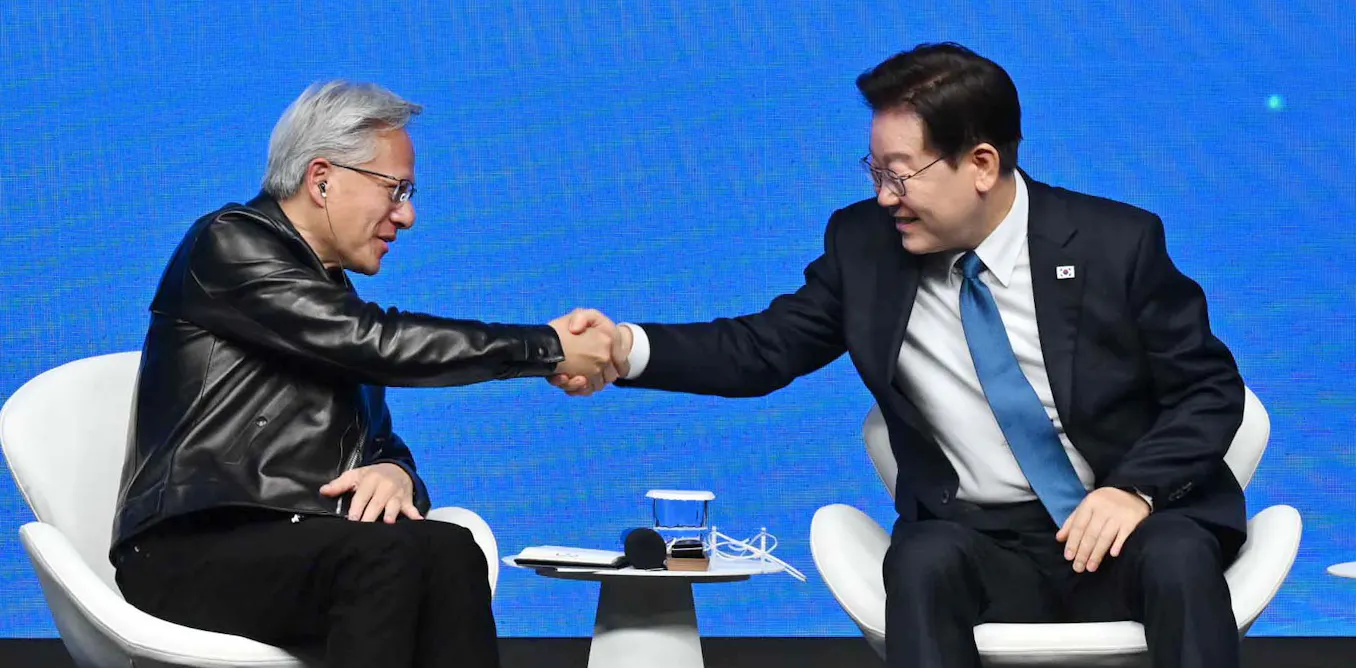
Jensen Huang, the founder and CEO of US tech firm Nvidia, is Taiwanese and on a recent visit to Taiwan exclaimed that the island is at the “epicentre” of the AI revolution. While Nvidia is the leading designer of AI processors, the physical manufacturing of these chips is outsourced primarily to Taiwan.
Taiwan’s focus now is on maintaining leadership in advanced chip production. The Taiwanese foreign minister, Francois Chih-chung Wu, said in late 2025 what many assumed to be the doctrine: that the most advanced chipmaking capabilities must remain in Taiwan.
TSMC has chipmaking facilities in Germany, Japan and the US. But these are not producing chips at the leading-edge; that is reserved for Taiwan.
Jack Hong / Shutterstock
South Korea is taking a similar approach to Taiwan. The country’s government and leading chipmakers, Samsung and SK Hynix, have recently announced an investment of nearly US$600 billion (£446 billion) in two new chip manufacturing plants in the south-west of the country.
Samsung and SK Hynix lead a distinct segment of the AI value chain from TSMC. They constitute nearly 80% of the global market for high-bandwidth memory chips. These chips provide the ultra-fast memory that AI processors rely on to train and run increasingly sophisticated models.
If the Nvidia-designed, TSMC-manufactured AI processors are the “brains” performing calculations, Samsung and SK Hynix’s high-bandwidth chips are the short-term memory that continuously supplies those processors with the data they need.
Seoul has also actively courted global AI leaders and chip designers. On his trip to Asia, Huang met with SK Hynix, LG and Naver chairmen. Before leaving, he asserted that South Korea is set to be a global leader in AI given its infrastructure strengths. American AI giant Anthropic is also reported to be collaborating with Samsung to develop a new AI chip.
Japan’s strategy looks different. Japanese AI investment commitments are smaller than in South Korea. Japan’s government has announced a target of US$65 billion of investment by its public and private sectors in physical AI by 2040. This is nearly a tenth the size of the Korean investment.
But this commitment has been followed by headlines that Japanese corporate giants SoftBank and Sony will lead Noetra, a consortium to develop an AI model to bolster robotics. The Japanese government sees physical AI applications like robotics as central to addressing the country’s demographic challenges and an area of competitive strength.
Nvidia is also embraced with open arms in Japan. In Huang’s July visit to Japan, the country’s strengths in AI for the factory floor, including automotive production and robotics, were emphasised. The Nvidia chief’s visit brought a collective sigh of relief in Tokyo as his earlier spring tour of Asia skipped Japan, which had stirred anxiety.

Franck Robichon / EPA
Vietnam starts from a lower technological base than its north-east Asian neighbours. However, it has outlined an ambitious catch-up strategy. Hanoi aims to train 50,000 chip engineers by 2030 and is courting major investments. This has included a commitment by Nvidia to build research and development and AI data centres in partnership with Vietnam’s telecoms giant, FTP.
Vietnam’s restrictions on the export of its unprocessed rare earth minerals reflect its longer-term ambition to manufacture chips, rather than only assemble and test them. Rare earths are important inputs into the advanced electronics, robotics and data-centre infrastructure that support the wider AI ecosystem.
Winning the race
Taiwan currently occupies the strongest position because it controls one of the most irreplaceable parts of the AI supply chain: manufacturing of the most advanced chips. South Korea follows closely through its combination of memory chips and industrial AI capabilities.
Japan’s strength lies in physical AI, injecting it in robotics. And while Vietnam is starting from a different position, it is pushing for future gains by investing in talent, critical minerals and facilities.
Success brings new challenges. The out-performance of South Korea and Taiwan’s AI chipmakers catapulted their national stock markets to new heights and then to quick collapse, fuelling consternation about both growing wealth inequality and volatility. In the short-run at least, “winning” the AI race bears social costs.
The broader lesson here is that AI competitiveness is not about becoming self-sufficient across the supply chain. Very few countries, even the US and China, can realistically achieve that. Instead, Asia’s middle powers are identifying how and where they can cultivate indispensability.
By specialising and building complementary strengths alongside major US technology firms, especially Nvidia, they are increasing both their economic competitiveness and their strategic relevance. This is how they are pursuing sovereignty through, not in, AI.
The post “How four Asian economies are positioning themselves for the AI age” by Robyn Klingler-Vidra, Vice Dean, Global Engagement | Associate Professor in Political Economy and Entrepreneurship, King’s College London was published on 08/04/2026 by theconversation.com