
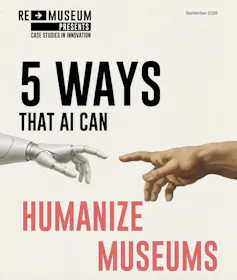
The cover of a new report on AI from a US museum thinktank restyles the Sistine Chapel’s Creation of Adam, with the hand of God replaced by a Terminator-style robotic one. So far so obvious.
In Remuseum’s Five Ways AI Can Humanise Museums, AI has presumably replaced God as the enabler of all things. But who is Adam’s hand supposed to represent: the museum visitor or the museum worker?
Or could it be the figure of the artist, being granted the power to create new worlds with AI? Creating worlds is exactly what artists can do, and paying attention to their creative and critical uses of AI is an urgent task for art museums today.
This article is part of our State of the Arts series. These articles tackle the challenges of the arts and heritage industry – and celebrate the wins, too.
Written by Remuseum’s founding director Stephen Reily, the report deftly introduces, by way of case studies from seven major American art museums, different ways in which the adoption of AI systems might enhance what they offer.
From communicating with visitors (many museums now have chatbots) to streamlining curatorial tasks, the report shares knowledge from projects which have used AI to develop marketing programmes, aid in fundraising, build relationships with sponsors, facilitate access to collection records online, train staff in new technology, and offer new means of art interpretation.
As a professor of museum studies, and a longtime curator of art that uses technology as both its medium and subject, my work has increasingly turned to consider AI. The report – which aims to inspire confidence by sharing practical examples – is interesting and useful, but I can’t help feel that it glosses over some of the more complex issues behind such innovations.
Museums in a technological age
It clearly calls out and thus aims to diminish resistance to AI from across the museum sector. “Avoidance is not an option,” the report declares – but much like the graphic on the cover, it risks oversimplifying some issues. There has been decades of research into how museums can better use technology, which suggests any resistance from museum staff to AI might be borne of something other than technophobia.
The report names one possible factor dampening museum workers’ enthusiasm for AI: that it will result in potential museum job losses. It answers this worry about AI taking jobs stating: “The best way to preserve and increase museum employment is to make museums matter to more people.”
Remuseum
While this doesn’t exactly address that concern, it introduces examples of how art museums have used AI to better connect with audiences, with all the tangible benefits that accrue from that increased brand visibility.
Why do museums matter to people, and to whom do they matter exactly? Do they matter to me because they offer cutting-edge exhibitions and events, educational and even life-affirming experiences? Or do they matter to you because they do the difficult work of preserving our cultural heritage, warts and all?
Art museums face a particular challenge, as how and why art matters to people is a much debated question. So knowing who art museums matter to and why, is the first step to developing more connected and personalised experiences for audiences, whether enabled by AI or not.
Using AI art to explain our technological age
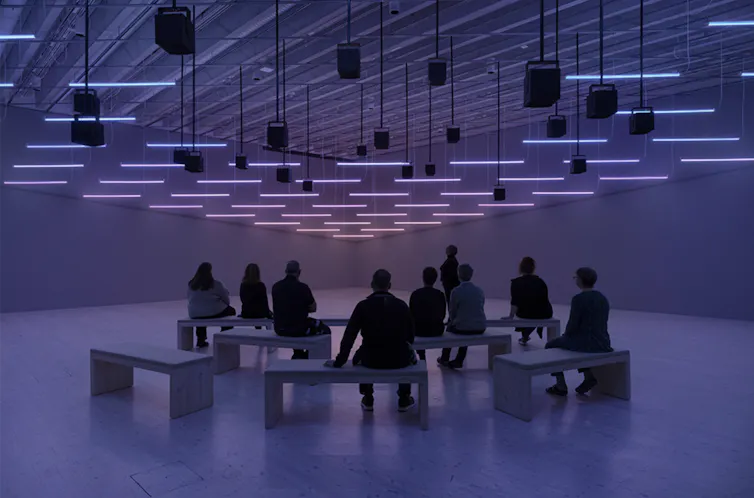
I was drawn to the opening case study which talks encouragingly about hosting artists in residence to work with new technologies. One example is the Toledo Museum of Art, which in 2023 exhibited UK-based artist Alexandra Daisy Ginsberg’s work Machine Auguries, a sound and light installation made with AI (which I first co-commissioned in 2019. Machine Auguries is a simulated dawn chorus of birdsong, inviting reflection on the relationship between technologies and nature.
The report proposes this is a way of increasing the understanding of digital art and the creative potential of technology, which can help make museum staff more open to AI.
Ideally the institution’s staff learn from these new artworks not just because they are made with new technologies such as AI, but because they are also often about new technology and its effects on society. Artists like Ginsberg are building new worlds for visitors to experience.
Malin Grönborg. / Bildmuseet
Such works demonstrate that sometimes an art museum is a place where audiences can encounter not just new technologies as the medium for an artwork, but also, its subject. For AI that means not just a demonstration of what it can do (“this artwork is made with AI”), but an interrogation of how it works (“this artwork is about how AI systems are trained to act on our behalf and how they affect us”).
The art museum then becomes, as I’ve long argued, a place where we all can take the time to think about – and through art, feel – what new technologies might mean for us in our world. This is a crucial way museums might “matter to more people” especially in times of technological change.
Of course questions remain. Who is encouraging art museums to choose AI in their operations, who is benefiting and who is losing out? What constitutes “responsible reuse of a museum’s own assets”? Is my data, as a visitor, such an asset? How do we deploy proprietary technology to make “real” art museum experiences matter to a greater number of visitors, without glossing over the complex stack of ethical and legal concerns that sit behind the rollout of any new technology?
This last question is one the report doesn’t quite get to, focused as it is on offering positive and useful examples of the successful deployment of AI in customer-facing activities.
But maybe we should pause and think about how we feel about the potential trade-offs, such as whose data is being shared, and with whom. Museums might want to do too, when it comes to their use of AI beyond the art they display in their galleries.
The post “Can AI help ‘humanise’ museums? New report reminds us why art matters in a changing world” by Sarah Cook, Professor of Museum Studies, University of Glasgow was published on 10/14/2026 by theconversation.com