
Generative artificial intelligence (AI), and especially large language models deployed as chatbots and digital assistants, are now part of everyday digital life.
These models are being framed as a helpful assistant, a patient tutor, a customer service agent and even a source of emotional support. But what happens when even more human encounters are mediated by machines?
This question matters especially in South Africa, where apartheid not only separated people by law, but also shaped who was seen, heard and recognised as fully human. Its legacy still lives in unequal access to education, healthcare, work, technology and public services.
This is also why ubuntu has become such an important part of South African debates about social life. Ubuntu is a way of thinking about personhood. It sees personhood as relational. It reminds us that dignity is not only individual. It is also formed through mutual belonging.
Ubuntu is expressed through the idea that “a person is a person through other persons”. People become themselves fully through relationships of recognition, care, responsibility and shared life.
As a scholar of technology and society, I have been exploring how AI is reshaping human relationships.
In my research on ubuntu and generative AI, I set about asking what this means in practice. What happens when machines begin to replace the human relationships through which people experience care, recognition and dignity? To answer this question, I used ubuntu as a lens to examine whether AI-mediated interactions can support the kinds of relationships through which human dignity is affirmed.
I argue that the rise of generative AI is more than a technical issue in two ways. Firstly, it is a relational one. Secondly, it’s about who gets access to human beings. In my paper, I describe this risk as a form of “relational apartheid”. By this I mean a social and technological pattern in which access to meaningful human engagement becomes unequally distributed. Some people are met by persons. Others are managed by systems.
This is not apartheid in the legal sense of the past. It is a warning about how old inequalities can reappear in new digital forms.
Simulated care is not the same as shared life
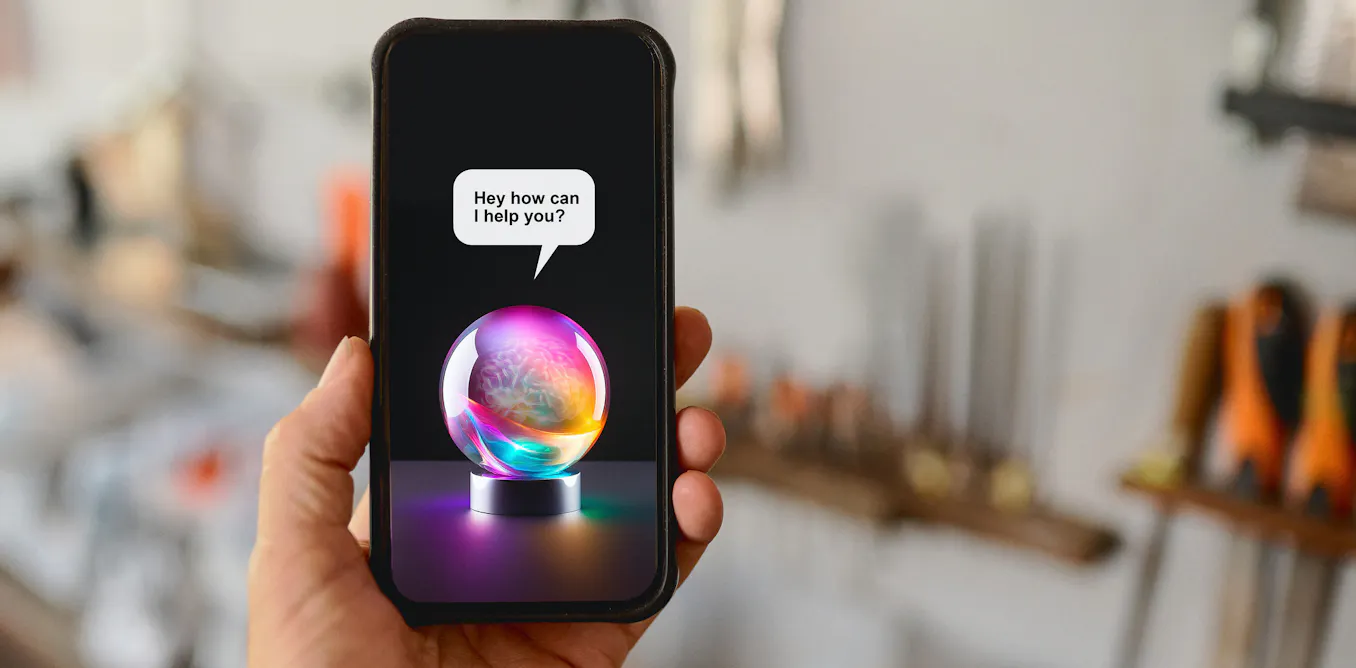
Large language models can now produce fluent and emotionally sensitive responses. They can apologise, encourage, advise and offer language that sounds consoling. They can remember details within a conversation and adjust their tone to the user. For many people, this can feel surprisingly human.
Yet the appearance of a relationship is not the same as a relationship.
A chatbot may respond warmly to a lonely student, a frustrated customer or a patient seeking reassurance. But it does not share in that person’s life. It cannot be vulnerable in return. It cannot be held accountable as a person. It cannot forgive, be forgiven, carry a moral burden or be transformed by the encounter.
Human relationships are difficult because they involve more than responsiveness. They involve mutual risk. We disappoint one another. We misunderstand one another. We apologise, repair and try again. These imperfect processes are part of what makes human relationships morally meaningful.
AI often offers a form of responsiveness without the mutual resistance found in human relationships. It can always be available, endlessly polite, and easily reset. That convenience is attractive. But it may also train us to expect relationships without the hard work of relationship.
The concern is not that every interaction with AI is harmful. AI tools can help people find information, write better, learn faster and access services. Used carefully, AI can create more space for human care rather than replace it.
The danger comes when AI is used as a substitute for human presence in areas where recognition matters.
Inequality is also about who receives human attention
Customer service offers one example. As organisations automate front-line support, people are increasingly routed through chatbots before they can reach a human being. This may reduce costs. It may also improve speed for simple queries. But it can create a tiered system in which some customers receive human attention while others are left with automated interaction.
The labour implications are also becoming visible. Salesforce, one of the world’s largest providers of customer service and business software, has reported that AI agents now handle a growing share of customer interactions. The company has also reduced thousands of support roles in recent years, although it would be simplistic to attribute all of these changes solely to AI. This does not mean all customer service work will disappear. But it does show how quickly routine service work can be reorganised once AI becomes the default front line.
Something similar could happen in healthcare, education and social support. Where human professionals are scarce, AI counselling tools, tutoring systems and advice bots may appear to offer a practical solution. In some cases they may help. But they also risk normalising a situation in which those who are already underserved are increasingly spoken to by machines rather than people.
In a society that the World Bank describes as among the most unequal in the world, old differences in income, education, language, geography and institutional power could reappear in new digital forms.
The problem is not only whether machines give accurate or inaccurate answers. The deeper problem is that some people may be denied the kind of encounter through which dignity is affirmed. A person does not only need a response. A person often needs to be recognised by another person.
Building ubuntu into AI
What about efforts to build ubuntu-aligned AI?
Scholars have explored how ubuntu might inform AI design, ethics and governance.
There is value in designing AI systems that are more sensitive to African languages, local histories and communal values. There is value in involving communities in decisions about how AI is built and used. There is also value in ensuring that technology does not simply import the assumptions of powerful companies and distant markets.
But can ubuntu simply be programmed into a machine?
Ubuntu is not only a set of polite phrases or cultural preferences. It is a way of thinking about persons in a relationship. It depends on shared life, mutual vulnerability and accountability. A system can be designed to support these values, but current AI systems cannot live them in the way people do.
This distinction is important for policy and design.
AI systems should be presented clearly as tools, not companions. They should not blur the difference between simulated care and real care, especially when used by children, elderly people, patients or socially isolated users. In sensitive settings, AI should support human professionals rather than replace them.
It may help South Africa improve public services, widen access to knowledge and support overburdened institutions. But it may also deepen the distance between people if efficiency becomes the main measure of progress.
The post “Could AI create a new form of inequality in South Africa?” by Rennie Naidoo, Professor of Information Systems, University of the Witwatersrand was published on 06/29/2026 by theconversation.com