
In a recent episode of British sitcom Amandaland, Anne Flynn turns to ChatGPT for help talking to her teenage son about sex. The episode frames this as “The Chat”: the awkward parent-child conversation many adults dread.
What Anne is doing on screen is what many people are now doing in private: taking hard human conversations to a machine that can answer immediately. The scene raises a bigger question: what do people need from another person when they are struggling, and can AI provide it?
Popular ideas about therapy often centre on expertise: the therapist as someone who can explain what is wrong and offer a way to fix it.
Therapy can involve psychoeducation and specialist techniques. But it also relies on the relationship between therapist and client, and the therapist’s ability to stay with uncertainty rather than provide an answer too soon.
At the University of Leeds, we ask trainee counsellors and psychotherapists to reflect on how quickly they may want to solve, reassure or interpret.
The capacity to tolerate uncertainty is treated as a clinical skill, developed through reflection, supervision and practice. Students are encouraged to notice the pull towards becoming the expert who supplies answers, and to consider what becomes possible when they stay curious instead.
This reflects what is known as a “not-knowing stance”. When therapists resist assuming they already know what a client’s experience means, the client is treated as the expert on their own life. The therapist still brings training and ethical responsibility, but remains open to discovering meaning with the client rather than imposing it.
Distress is rarely just a puzzle to be solved. People may arrive in therapy wanting answers, explanations or relief. But if a therapist moves too quickly into advice, interpretation or diagnosis, they can miss what the client is really trying to say.
The not-knowing stance asks the therapist to remain curious and present, when the person in front of them feels overwhelmed.
Importance of alliance
Researchers call the relationship between therapist and client the “therapeutic alliance”: the trust, connection and shared purpose that allows therapy to happen.
A major review showed that this alliance is reliably linked with therapy outcomes, with stronger alliances tending to be associated with better results in therapy. Later research has found that the alliance is crucial across different types of therapy.
Therapeutic approaches still matter, and some difficulties require specialist treatment. But research on the common factors in psychotherapy suggests that shared elements – including empathy, collaboration and the belief that therapy can help – are central to how therapy works.
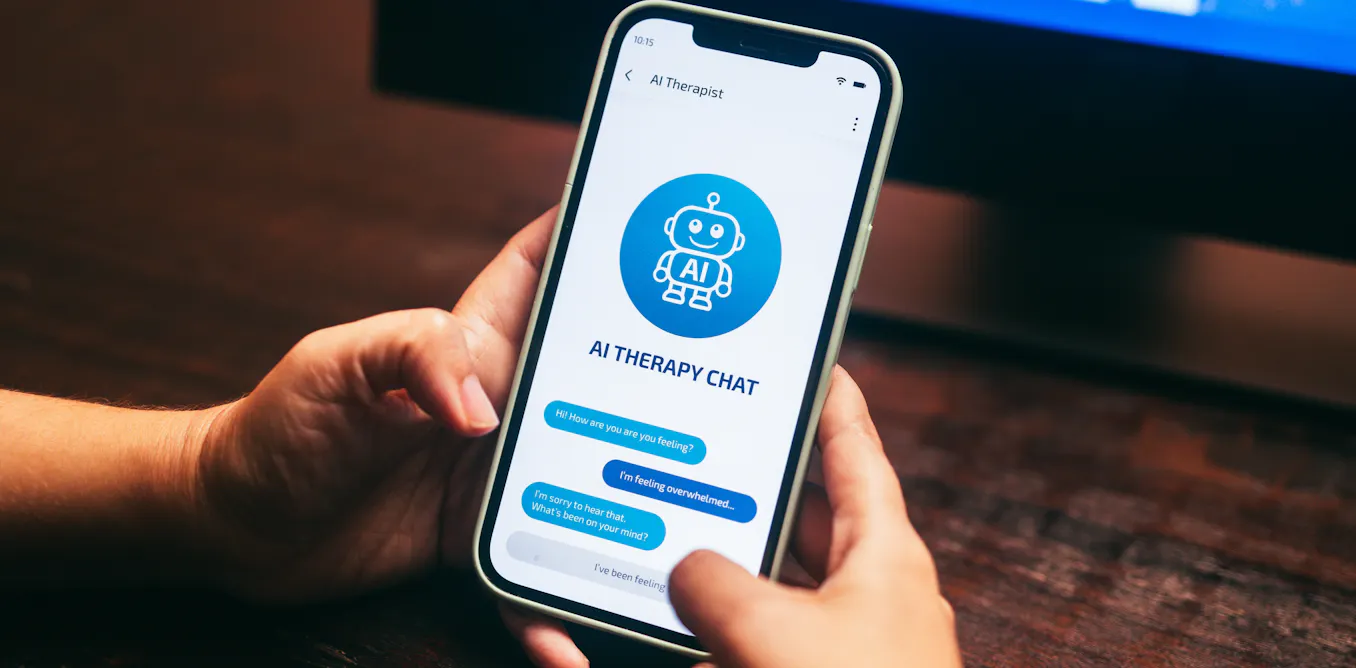
The appeal of AI in difficult moments is understandable. Research into people who repeatedly use ChatGPT for emotional and mental health support suggests that some users value it because it feels accessible and non-judgmental. Chatbots are available at 3am and respond instantly in language that sounds caring. For someone unable to access support, that may feel like a lifeline.
There is also growing research into AI in mental health care, including chatbots, digital interventions and large language models – systems trained on huge amounts of text to generate human-like responses.
Reviews suggest these tools may have potential in screening, psychoeducation and access to support. But the evidence base is still developing, and concerns remain around safety, privacy and over-reliance. A systematic review of AI in mental health care and a scoping review of large language models in mental health care both (in 2025) stressed the need for stronger evaluation and safeguards.
Research on the digital therapeutic alliance shows that people can experience something relationship-like with mental health chatbots. A chatbot can sound curious and compassionate. It can mirror a user’s words, suggest breathing exercises or help someone plan a difficult conversation.
But relationship-like support and reciprocal human presence are different. Human therapists can respond to far more than words: hesitation, silence, tone, expression, and the moment someone says something important while pretending it is ordinary.
Therapists can be surprised, concerned, challenged and changed by the encounter. They also carry ethical and professional responsibility for what happens in the room.
Presence and accountability
The not-knowing approach rests on intersubjectivity: the way two people affect and are affected by each other. Research on synchrony in psychotherapy suggests that therapist and client may coordinate aspects of voice, movement and physiology during therapy, as their responses begin to align in subtle ways. These embodied processes show why therapy is more than an exchange of words.
A language model does not have that kind of presence. It can identify patterns in language, but it cannot notice a client’s hand tightening around a tissue, hear the change in someone’s voice when they mention a name, feel concern or take ethical responsibility for the relationship.
There are also ethical concerns about agency: the client’s capacity to make sense of their experiences and make choices for themselves. Recent work on AI and agency in psychotherapy warns that chatbots and human therapists support agency in different ways. An AI system may shift authority towards a tool that does not know the person and may produce confident answers when caution is needed.
AI may help some people prepare for a conversation, find words for a feeling, practise asking for help, or access basic information when nothing else is available. Support and therapy have different responsibilities, though. A chatbot may be available whenever the user returns. That differs from staying with someone in a mutual, accountable human relationship.
When a therapist can say, honestly, “I don’t know what this means for you yet, but I’m here and I want to understand,” they are offering something no algorithm can replicate: a trained human presence that can listen, respond and remain accountable.
The post “The danger of confusing AI mental health support with therapy” by Netalie Shloim, Lecturer in Counselling & Psychotherapy, School of Healthcare, University of Leeds was published on 06/23/2026 by theconversation.com