
This year, members of Seattle Mountain Rescue have been setting off into the wilds of the US Pacific north-west wearing an unusual piece of kit.
They’ve been hiking into the wilderness with powered assistive devices attached to their hips and legs. Designed to increase lower-body strength when climbing or carrying heavy loads, these pieces of equipment are being tested to see if they can boost rescuers’ speed and endurance when it matters most – during searches for stranded people.
Devices like these are called human exoskeletons. They attach to parts of the body to create an external – or “exo” – mechanical structure. This powered frame enhances the wearer’s physical capabilities.
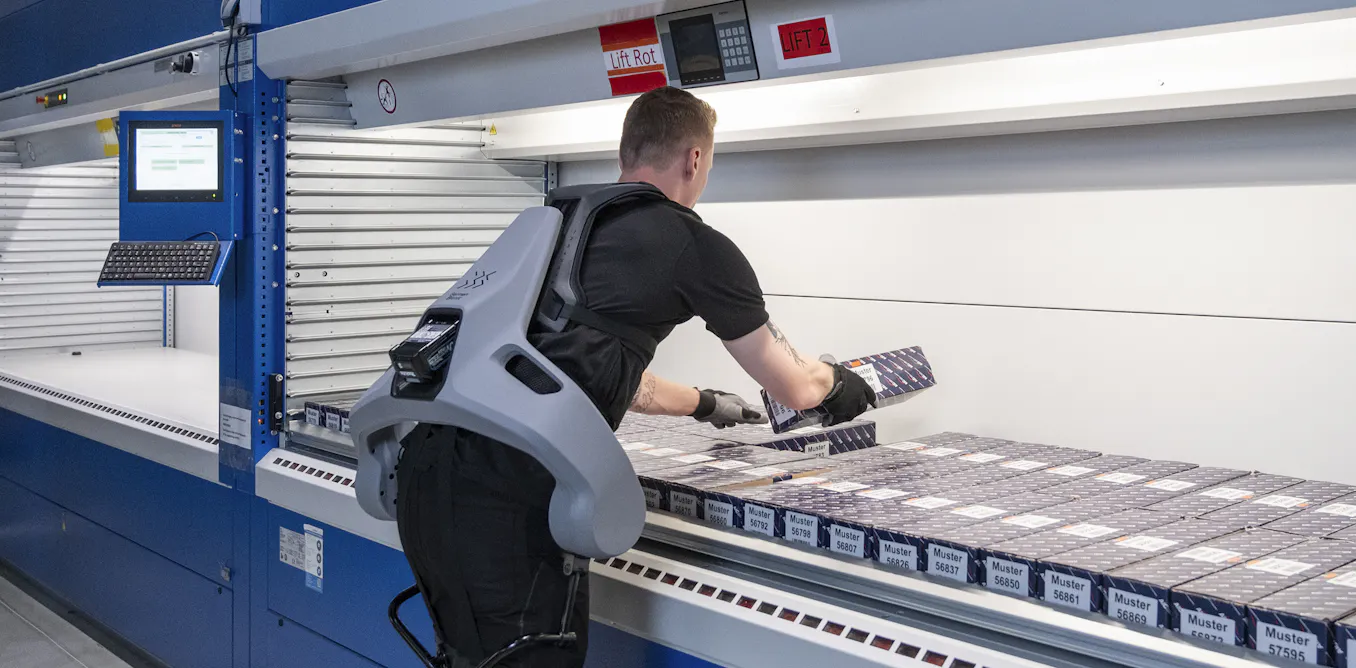
In physically demanding fields, workers are increasingly using these devices during strenuous tasks. IKEA has used SuitX exoskeletons for several years now. These assist warehouse workers with handling heavy materials. Ford, Boeing and Mazda Toyota have also all adopted the tech on some of their assembly lines.
Technology that boosts people’s physical and mental abilities is no longer the preserve of science fiction. In this series, we explore cutting-edge ways that human capabilities could be augmented both now and in the near future – and the ethics of these innovations.
In Finland, a recent project called ExoPELA assessed whether exoskeletons could reduce muscle load and strain in rescue and firefighting work. It found noticeable benefits for users in certain real-world tasks.
And in early 2026, the Ukrainian military revealed its soldiers had been using Hypershell exoskeletons on the front lines to help with carrying artillery shells. According to test results, soldiers wearing the devices “become less fatigued, work faster, and maintain combat effectiveness for longer,” Colonel Vitalii Serdiuk told the Ukrainska Pravda newspaper in March.
Multiple consumer and clinical devices, designed for everyday assistance, rehabilitation and exercise, are also now available. Some estimates have valued the total sector at around US$500 million (£370 million) currently, and predict it could double or triple in size by the mid-2030s.
Exoskeleton technology has progressed significantly over the past decade. This has largely been thanks to robotic motors, sensors and control systems becoming more affordable and accessible. However, the concept of augmenting human performance with exoskeleton-like devices dates back much earlier.
One of the earliest known concepts was patented in 1890 by Nicholas Yagn, a self-taught Russian inventor, who designed a wearable apparatus for exercising. And in 1919, the American Leslie C. Kelley received a patent for a steam-powered device to support walking, one of the first powered exoskeleton concepts.
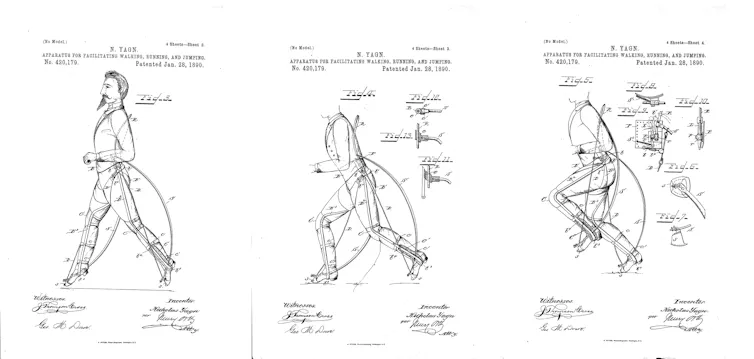
United States Patent Office/Google Patents
By the end of the 1960s, multiple actuated robotic exoskeletons incorporating electronic control systems had been developed. Since then, exoskeleton research and development has advanced rapidly, leading to the emergence of numerous devices with commercial and clinical applications.
How they work
Exoskeletons generate forces to make the wearer stronger, move faster or fatigue slower.
Some devices also improve movement accuracy and dexterity or support overall posture. Some are designed to elevate human capabilities beyond what is typically possible. Others help patients with reduced physical capacity.
Modern, active robotic exoskeletons typically consist of a lightweight mechanical frame with ergonomic attachments to the human body. These are usually affixed at the trunk, waist and to upper or lower limbs.
For example, the Hypershell device seen in Ukraine attaches to the user’s waist and thighs, to assist with hip flexion and extension and strengthen lower-body movement. The SuitX device used by IKEA attaches to the torso and upper limbs, to support the back and shoulders.
In most powered exoskeletons, mechanical components called actuators convert electric power from batteries into mechanical movement, generating forces that support or enhance the body’s movement.
The actuators are coordinated by control units embedded in the exoskeleton. These define the trajectories of the exoskeleton’s movements and how much force it applies to the wearer’s body. Exactly how the device moves, and how forcefully, will depend on the task and the state of the user – with the device using sensors to determine what’s needed.
For instance, if a wearer starts running, an exoskeleton will speed up its supportive movements. If it senses they’re beginning to fatigue, it might increase its power output to compensate.
Control units are normally pre-programmed for specific tasks, though modern exoskeletons are increasingly becoming more adaptive. Some are equipped with algorithms that learn from users’ actual working behaviours to better support their actions.
However, assistance exoskeletons provide generally falls into three categories.
Power augmentation increases the force capabilities of the user. This is commonly seen in assistive exoskeletons, like those being used by IKEA and in Ukraine.
Assist-as-needed or resist-as-needed settings provide support to the body only when necessary. This setting is often used in rehabilitation devices, to help users train their bodies to recover lost capabilities.
Finally there’s full robotic control, where the exoskeleton assumes complete control over part of the body. This tends to be for users who have lost certain motor functions. For example, a lower-body exoskeleton might use full robotic control to allow someone with spinal cord injury to walk.
These ways of working can be combined and adapted according to the specific task, environment and needs of the user.
What’s next?
For now, most exoskeletons rely on feedback from sensors to define how they exoskeletons behave; they’re wholly mechanical. But in the future exoskeletons could be operated with signals from the wearer’s muscles or brain. Research is exploring this, but it remains a challenge. Harnessing these signals might require an invasive interface and extensive user-specific calibration and adaptation.
Power is another current challenge. Batteries have to be integrated into exoskeletons and regularly recharged. This introduces weight and size constraints that affect practicality. The energy density of batteries is steadily improving, however.
New materials are also pushing the boundaries of what’s possible. Exoskeletons are being developed that are made from soft textile or rubber-like materials that can be integrated into clothing, footwear or protective equipment.
Research into walking exoskeletons during the 1960s and 1970s contributed to the development of the first humanoid bipedal robots. This has come full circle. Interest in humanoid robotics is now accelerating the development of actuators and batteries. These will advance the wearable robotic technologies of tomorrow.
The post “The dawn of the age of the exoskeleton” by Ildar Farkhatdinov, Senior Lecturer in Healthcare Engineering (Robotics and Mechatronics), King’s College London was published on 09/30/2026 by theconversation.com