
Two decades after the launch of social media, Meta settled a lawsuit in August in the United States about the negative impact of Facebook and Instagram on teens’ well-being.
The company paid US$18 billion and agreed to limit teens’ access to prevent American government regulation.
Just before this, in June, the Canadian government finally announced its own regulations, the Safe Social Media act, forcing platforms to remove harmful content.
While better late than never, neither the American or Canadian intervention addresses AI chatbots. We should be concerned not only about about the effects of AI on teens’ safety, but also, as recent data from global standardized testing suggests, on teens’ learning.
Read more:
A safe AI strategy for Canadian youth should include age-associated risks
AI and schoolwork
In September, data from the OECD’s Program for International Student Assessment (PISA) was released. PISA is a recurring, worldwide assessment of 15-year-olds’ science, mathematics and reading ability.
In Canada, 24,600 students from 897 schools completed the 2025 assessment. This year’s report focused on science and asked teens how frequently they use AI for learning, how they use it and why.
Data from more than 760,000 15-year-olds indicated that 86 per cent of teens globally use AI for school, and teens who use AI for schoolwork every week score one year behind teens who never use AI. Canadian students who use AI every week score two years behind.
Overall, PISA scores have been declining since 2006. The same is true in Canada.
The latest decline since 2022 happens to coincide with the release of ChatGPT, but that’s not evidence of causality. Instead, we must look at the data to see how students are using AI globally, how Canadian students compare and what this suggests about how AI is impacting learning.
How teens use AI for learning and why
Teens report using AI chatbots for school a lot. Among students who use AI weekly, the reported uses are:
-
“To help me learn” (38 per cent Canada, 46 per cent globally);
-
To research new topics (23 per cent Canada, 31 per cent globally). Students didn’t report why they did this, for example whether this was to supplement an online or library search or instead of these;
-
To summarize a reading (23 per cent Canada, 30 per cent globally);
-
Most concerning, to generate texts for assignments (18 per cent Canada, 29 per cent globally) instead of writing them themselves.
Still, many Canadian teens report never using AI; 50 per cent of Canadian teens report never using AI to generate text.
If they’re not trying to skip the homework, why are they using AI?
(Adam Kenneth Dubé)

(OECD)
Curiosity and AI
To understand what drives learning, teens were asked about their curiosity. Globally and in Canada, students who reported higher levels of curiosity used AI more frequently.

(OECD)
Students who reported asking teachers, classmates, friends or parents for help when they need it (a hallmark they are monitoring their learning) either never used AI or used it every day.

(OECD)
This data suggests teens are using AI to help them learn, not cheat, and are driven by curiosity.
Unfortunately, the data also suggests using AI doesn’t help most teens with their learning, particularly Canadians.
How AI impacts learning
Both globally and in Canada, the overwhelming trend is that students who use AI more also report worse scores in science.
Students in Canada who use AI to summarize text every day show a 38-point lower score in science versus those who never use it.
Canadian teens using it to draft text show a 42-point lower score. These gaps are equivalent to two years of learning loss.
While students who “use AI to learn” and conduct research show smaller drops in science scores, data from all four uses suggest there’s no helpful way to use AI for learning.

(Adam Kenneth Dubé)
Why such deficits? Could it be a socio-economic status (SES) gap that creates learning barriers? No: Canadian AI users are more likely to be from high-SES schools.
It is more straightfoward: if AI is reading and writing for you, then you’re not learning.
Does teaching students how to learn with AI help?
Perhaps these learning gaps can be addressed by teaching students to use AI more judiciously? To this end, the Canadian government just launched free AI literacy training for students.
To test this in the PISA data, let’s compare students who were taught how to evaluate AI-generated content to those who weren’t.
Globally and in Canada, of students who use AI everyday, those with training scored higher than students without.
But, these trained AI users didn’t differ much from never-AI students (Canada: two points lower; Global: five points higher).
AI literacy training may help prevent AI-associated learning losses, or, for approximately the same outcome, students could simply not use AI.

(Adam Kenneth Dubé)
What to do about it
In Canada, 38 per cent of teens use AI every week to learn, but they score two years behind. What to do?
We need to identify the problem. A recent study argues we should think of technology impacts as a public health issue, one driven by evidence and regulated.
How to regulate? Canadian experts on AI, learning and children wrote a policy brief calling for an expansion to the Safe Social Media Act. I am a member of this group, and we argue technology companies must remove design features from tech that encourage use at all costs.
For AI, this means designing teen-ready AI and not training teens to be AI-ready.
OpenAI released ChatGPT for Teens in August, but Common Sense Media’s Youth AI Safety Institute rates it an Unacceptable Risk for safety. We should be similarly concerned about student learning.
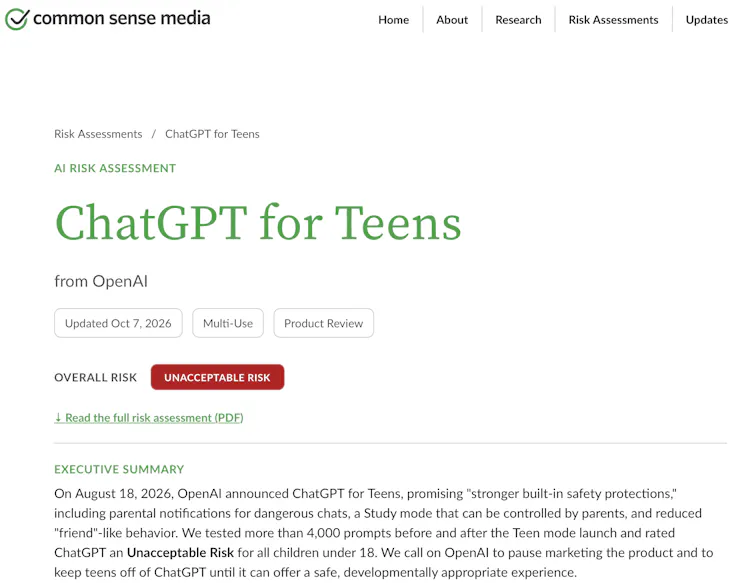
(Common Sense Media)
To be suitable for teens, chatbots should not contain:
▪ Excessive validation (sycophancy);
▪ Systematic follow-up questions;
▪ Simulation of human characteristics (for example, human-like names, avatars, personalities);
▪ Simulation of emotions and human relationships;
▪ Personalization that encourages attachment;
▪ Daily tasks and systems notifications (for example, reminders to engage with the system);
▪ Advertisements disguised as conversations;
▪ Overconfident language (regardless of accuracy or sourcing).
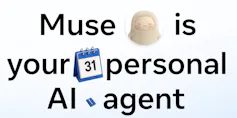
We must act before the next wave of AI. Both Meta and OpenAI just released their agentic AI chatbots (Muse and Dots) with cartoon mascots and promises like: “Muse is a personal AI agent. It doesn’t just answer questions, it actually does the work.”
The release of AI chatbots since 2022 has harmed teens’ education. Governments cannot afford to wait another two decades to regulate AI.
The post “The release of AI chatbots has harmed teens’ learning and Canada needs to act” by Adam Kenneth Dubé, Associate Professor of Learning Sciences, Faculty of Education, McGill University was published on 10/14/2026 by theconversation.com