
Earth’s orbit is getting crowded.
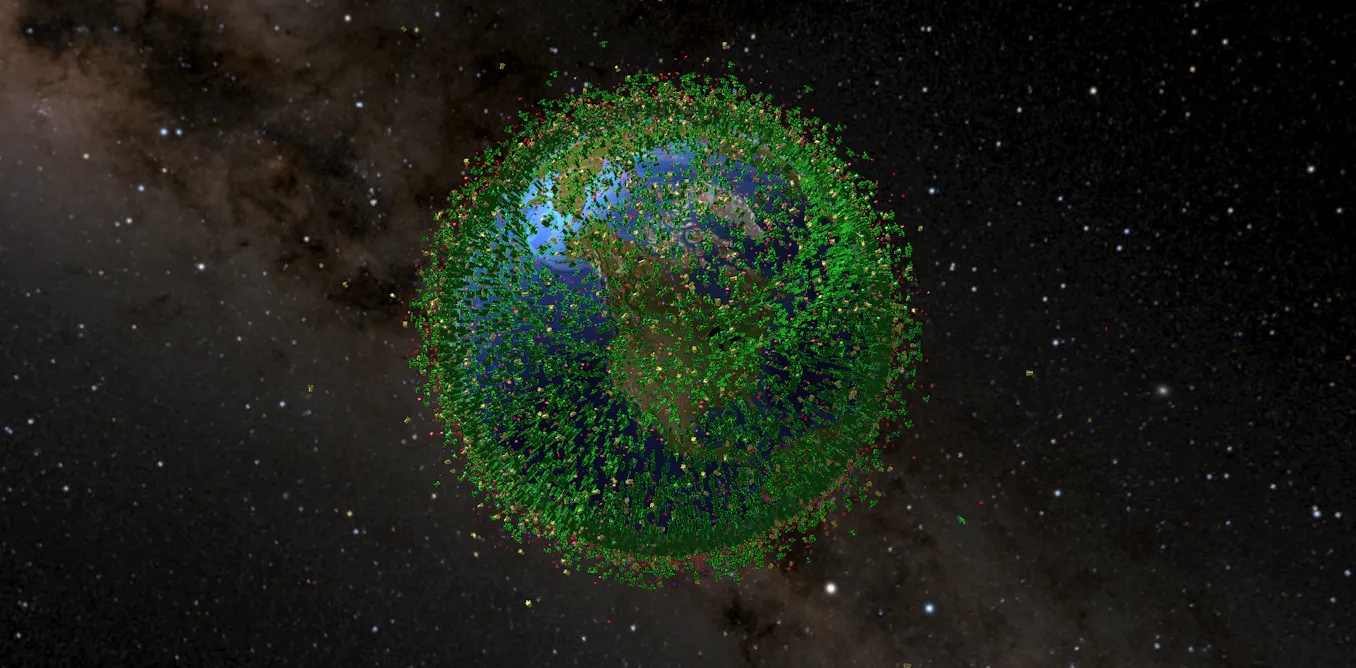
About 16,000 satellites currently circle our planet, supporting everything from GPS navigation and weather forecasting to banking, emergency services and internet communications.
Dozens more are launched every few weeks. Some estimates suggest the total number of satellites could exceed 100,000 within this decade, with more conservative estimates landing on up to 60,000 satellites by 2030 – still a staggering amount.
This rapid growth is creating an important challenge. How do we safely manage an increasingly crowded orbital environment while ensuring the satellites we depend on continue to work reliably?
The risks are not difficult to imagine. Large satellite constellations increase light pollution and other disruptions to astronomy and the night sky. More satellites mean more traffic, a greater chance of collisions and an increasing amount of space debris.
Read more:
Too many satellites? Earth’s orbit is on track for a catastrophe – but we can stop it
In a worst-case scenario, space debris can cause a runaway chain reaction known as Kessler syndrome, which would ensconce Earth in a cloud of debris and render its orbit unusable, without the ability to launch satellites or any other space missions.
Even short of this, ageing or damaged satellites can become hazards if they stop working, collide with other objects, or eventually make uncontrolled re-entries through the atmosphere.
This raises a practical question – satellites can’t simply be brought home for repairs. So how do we maintain tens of thousands of machines that are hundreds of kilometres above Earth?
The Conversation, CC BY-SA
Satellites don’t last forever
The challenge of satellite maintenance became more visible in March this year when a large NASA satellite made an uncontrolled re-entry into Earth’s atmosphere.
The US Space Force confirmed the spacecraft re-entered over the eastern Pacific Ocean, and NASA expected most of it to burn up, though some components may have survived. The event attracted worldwide attention as experts tracked its descent and estimated where debris might land, including the possibility that large debris could one day cause damage in populated areas.
The incident was a reminder that satellites don’t last forever. Like any machine, they age. Batteries degrade, electronic components wear out and harsh space conditions gradually take their toll.
Unlike aircraft or cars, however, we can’t easily take satellites to a repair workshop.
Once launched, they must continue operating in an environment of intense radiation, extreme temperature changes and constant mechanical stress. Servicing missions are technically possible, but remain expensive and relatively uncommon.
How do we keep satellites ‘healthy’?
Today, satellite health is monitored largely from the ground.
Engineers receive streams of telemetry data showing battery performance, temperatures, power consumption and the status of onboard systems. They analyse this information and look for warning signs that something may be going wrong.
This approach has worked well for decades. But it may become increasingly difficult as satellite constellations grow from dozens of spacecraft to hundreds or even thousands. Human operators can only monitor so much information at once.
This is where recent advances in artificial intelligence (AI) may help. Researchers have been investigating how AI can identify early signs of satellite degradation before they become mission-threatening failures.
One important example involves batteries. Satellite batteries gradually lose performance over time, much like the battery in a smartphone or electric vehicle.
If this degradation can be detected early, operators may be able to adjust how a satellite is used, extend its operational life or avoid unexpected failures. They could do this by sending new instructions to the satellite, such as reducing power-hungry activities, changing when data are processed or transmitted, or placing non-essential systems into standby.
Our recent research used publicly available NASA satellite battery data to explore how machine learning (a type of artificial intelligence) can recognise patterns associated with battery ageing and predict future performance.
The goal is similar to predictive maintenance systems already used in modern aircraft, wind farms and manufacturing plants. Rather than waiting for equipment to fail, AI looks for subtle changes that suggest problems may be developing.
Satellites can learn from each other
In our approach, we also considered federated learning.
Normally, enormous amounts of satellite data would need to be transmitted back to Earth for analysis. This requires time, bandwidth and energy. Federated learning offers a different approach. Individual satellites can “learn” from their own experience and share useful insights with other satellites or ground systems without constantly sending every piece of raw data.
In simple terms, satellites could help each other become better at recognising potential faults. Over time, this could support continuous self-monitoring across large satellite networks.
There are, however, important limitations.
AI can’t prevent every satellite failure. It can’t eliminate space debris or solve orbital congestion on its own. Predictive models require extensive testing, such as checking them against historical satellite data, simulated faults and laboratory battery experiments before they are trusted in orbit. And any autonomous decision-making systems must be reliable enough for safety-critical applications while remaining under human oversight.
The next great challenge of the new space age may not simply be launching another 100,000 satellites. It may be ensuring those satellites are intelligent enough to monitor their own condition, detect problems early and help keep the space services we rely on running safely and reliably.
The post “There are already 16,000 satellites in Earth’s orbit. How will we manage the next 100,000?” by Tony Jan, Professor of Information Technology and Director of Artificial Intelligence Research and Optimization (AIRO) Centre, Torrens University Australia was published on 07/20/2026 by theconversation.com