
Artificial intelligence has made impressive progress.
Models can classify images, generate text, and even plan complex sequences of actions. But when you take AI out of the digital world and place it into a factory, a warehouse, or any physical environment, something breaks.
The AI can decide.
But it can’t reliably act.
This is the gap that defines Physical AI—and it’s where most real-world robotics projects succeed or fail.
The gap between thinking and doing
In simulation, everything is clean and predictable.
Objects are perfectly modeled. Lighting is ideal. Physics behaves exactly as expected.
In the real world, none of that is true.
- Parts vary slightly from one batch to another
- Surfaces reflect light differently throughout the day
- Objects shift, slip, or deform during handling
- Contact forces are uncertain
An AI system might correctly identify an object and decide how to pick it. But without the ability to adapt during the interaction, that decision often fails in execution.
This is why many AI-driven robotics demos look impressive—yet struggle when deployed on the factory floor.
Perception isn’t enough
Most AI development in robotics has focused on vision.
And vision is important. It helps robots locate objects, understand scenes, and plan actions.
But vision alone doesn’t close the loop.
Humans don’t rely only on sight to manipulate objects. We use touch, force, and feedback continuously:
- We adjust our grip when something starts slipping
- We feel contact before applying force
- We adapt instantly to small variations
Without this feedback, even simple tasks become unreliable.
The same is true for robots.
Physical AI requires a full loop: sense → decide → act → adapt
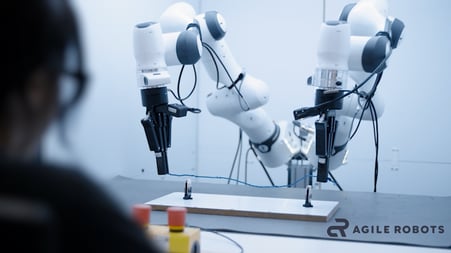
To operate reliably in the real world, robots need more than intelligence. They need a closed-loop interaction system.
That loop looks like this:
- Sense – Vision, force, and tactile inputs
- Decide – AI models or control logic determine the action
- Act – The robot executes the motion
- Adapt – Real-time feedback adjusts the action during execution
Most current systems stop short of this loop.
They sense and decide, but don’t adapt effectively once contact begins.
That missing “adapt” step is where failures happen.
Why manipulation is still the hardest problem
Moving a robot arm from point A to point B is a solved problem.
Interacting with the real world is not.
Grasping, inserting, aligning, or handling objects introduces uncertainty that AI alone cannot resolve.
The challenge isn’t just planning the motion. It’s handling what happens during the motion:
- Slight misalignment during insertion
- Unexpected resistance when pushing a part
- Object slipping during a pick
- Variations in material stiffness or friction
Without feedback, the robot either fails or requires extremely tight control of the environment.
And tightly controlled environments don’t scale.
The role of hardware in making AI work
There’s a tendency to treat AI as the primary driver of progress.
But in Physical AI, hardware plays an equally critical role.
Adaptive grippers, force-torque sensors, and compliant mechanisms don’t just execute actions; they make those actions more robust.
They reduce the precision required from AI models by absorbing variability physically.
Instead of needing perfect perception and planning, the system can rely on:
- Mechanical compliance
- Force feedback
- Simpler grasp strategies
This is what enables real-world reliability.
Not perfect AI, but systems designed to handle imperfection.
From demos to deployment
The difference between a demo and a deployed system often comes down to one question:
Can the robot recover from small errors on its own?
In many AI-driven demos, the answer is no.
Everything works because the environment is controlled.
In production, variability is constant. And systems that can’t adapt require:
- Frequent human intervention
- Complex reprogramming
- Tight process constraints
That’s where projects stall.
Physical AI isn’t just about making robots smarter. It’s about making them more resilient to reality.
W
hat this means for robotics team
s
If you’re building or deploying robotic systems, this shift has practical implications:
- Don’t evaluate AI in isolation; evaluate the full interaction loop
- Prioritize systems that can adapt during contact, not just before
- Use hardware to simplify the problem whenever possible
- Design for variability, not perfection
The goal isn’t to eliminate uncertainty.
It’s to handle it effectively.
Closing the gap
AI has reached a point where decision-making is no longer the main limitation.
Interaction is.
Physical AI is about closing that gap: connecting intelligence to the real world through sensing, action, and adaptation.
Because in robotics, the question isn’t just:
“Does it work?”
It’s:
“Does it still work when reality gets messy?”
Ready to take the next step?
If you’re working on a robotics application and running into challenges with reliability, variability, or deployment at scale, you’re not alone.
Talk to a Robotiq expert to explore practical ways to simplify your system, improve robustness, and move from a working concept to a scalable solution.


The post “AI can decide. But can it act? The missing layer in Physical AI” by [email protected] (Louis-Alexis Demers) was published on 04/16/2026 by blog.robotiq.com