
Across Italy and the DACH region, food manufacturers are facing the same reality:
- 📈 Increasing production demand
- 👷 Labor shortages and rising costs
- ⚠️ End-of-line processes limiting throughput
And more often than not, the bottleneck isn’t where you think.
👉 It’s palletizing.
The challenge: Scaling without hiring
A premium Italian manufacturer of chocolate, pastries, and snacks recently faced this exact situation.
Their setup was simple — but limiting:
- 1 operator per palletizing station
- €40,000/year labor cost
- 1 shift, 1 line
Scaling production meant only one thing:
➡️ Hiring more operators
But in today’s labor market, that’s:
- Expensive
- Unreliable
- Hard to sustain long-term
So they asked a better question:
👉 “How can we increase output without increasing labor?”
The application: typical (and challenging) food industry constraints
This wasn’t a niche use case. It’s exactly what many manufacturers deal with daily:
- 📦 Cardboard boxes up to 17 kg
- ⚡ 6–10 picks per minute
- 📏 Pallets up to 1,700 mm
- 🧩 Interlayers required
- 🔄 Boxes arriving via conveyor, consistently oriented
In other words:
👉 Too demanding for manual scaling
👉 But traditionally seen as too complex for flexible automation
The solution: Robotiq Lean Palletizing (PE20 model)
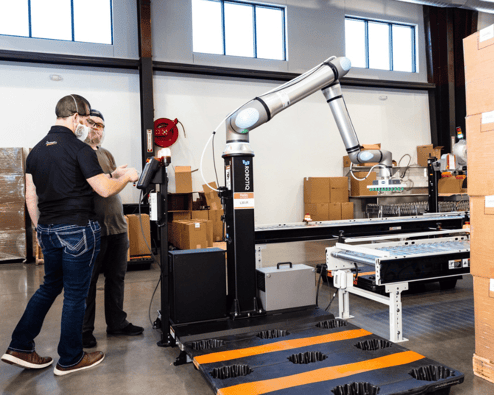
Instead of going with a rigid, high-cost automation system, the manufacturer selected:
👉 Robotiq PE20
Because it’s designed specifically for manufacturers who need:
✅ Fast deployment
No major layout changes. No long integration cycles.
✅ Safe collaboration
Operate without fencing — ideal for existing production environments.
✅ flexibility
Handle multiple SKUs, box sizes, and pallet patterns without re-engineering.
✅ Ease of use
Operators can run the system without robotics expertise.
The results: Immediate ROI and scalable growth
💰 €40,000 saved per year — per station
By removing one manual palletizing role:
- Labor costs dropped instantly
- Payback became highly predictable
📈 Increased throughput
With a stable pick rate of 6–10 picks/min:
- No more end-of-line bottlenecks
- Production can scale with confidence
📦 Better pallet quality
- Consistent stacking
- Integrated interlayer handling
- Reduced product damage
🔄 Future-proof operations
As production evolves:
- New products? No problem
- New formats? Easily configurable
- New demands? Already covered
Why this matters for Italian & DACH manufacturers
If you’re running a food production line in:
🇮🇹 Italy
🇩🇪 Germany
🇦🇹 Austria
🇨🇭 Switzerland
You’re likely dealing with:
- High labor costs
- Workforce shortages
- Pressure to increase efficiency
👉 The reality:
Manual palletizing doesn’t scale anymore.
👉 The opportunity:
Automation doesn’t have to be complex or risky.
The smartest first step in automation
Many manufacturers think they need to automate entire lines.
But in reality:
👉 Palletizing is often the fastest, lowest-risk entry point into automation
- Quick ROI
- Minimal disruption
- Immediate impact
Is your application a good fit?
Not every palletizing setup is the same.
The real question is:
👉 Will this work for your boxes, your rates, your layout?
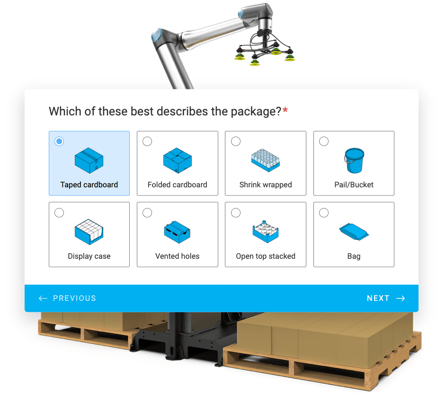
Try the Palletizing Fit Tool (2 Minutes)
Get a clear answer instantly:
- ✔️ Check if your application is compatible
- ✔️ Estimate ROI based on your inputs
- ✔️ Get a recommended configuration
👉 Start your evaluation now with the Palletizing Fit Tool


The post “How food manufacturers in Europe are automating palletizing without adding headcount” by Alessio Cappellaro was published on 04/07/2026 by blog.robotiq.com