
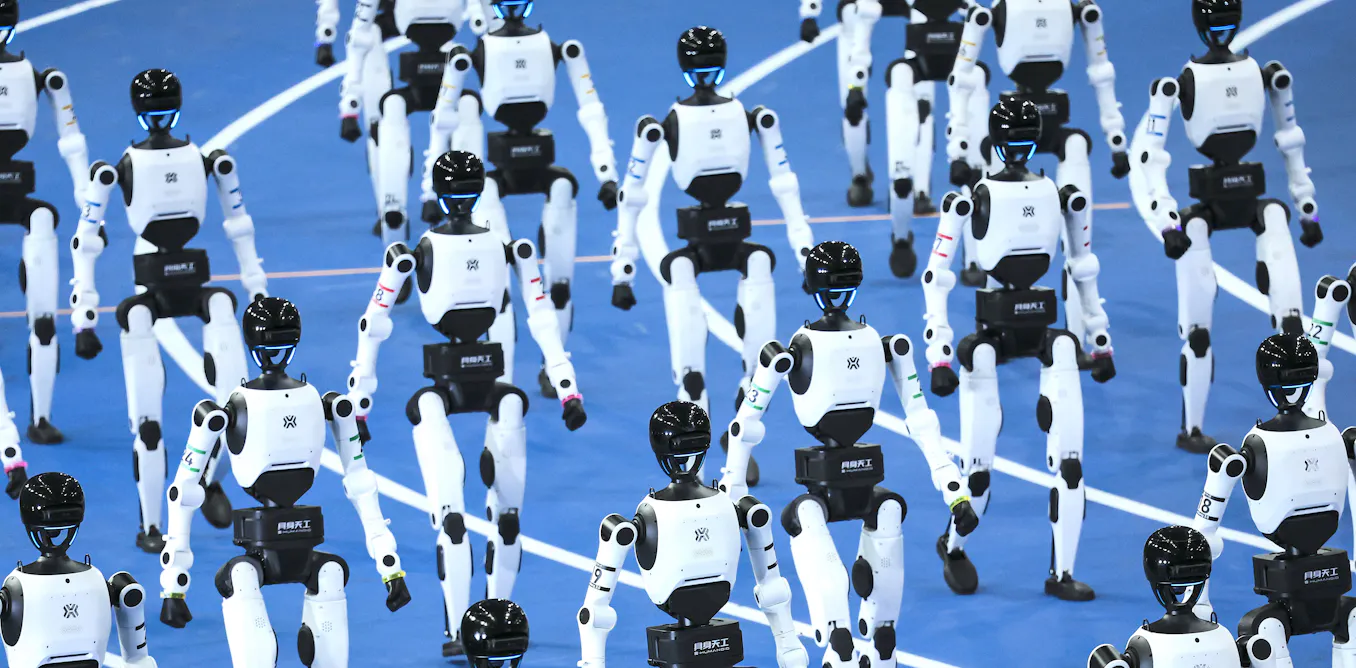
At the World Humanoid Robot Games in Beijing, a humanoid robot
named Tiangong Ultra ran the 100-metre sprint in a staggering 8.64 seconds, shattering Jamaican sprinter Usain Bolt’s legendary human world record of 9.58 seconds.
The internet laughed at the robots’ awkward, lurching finishes and spectacular falls – but the laughter masked a chilling reality.
Just two days after the games concluded the official newspaper of China’s People’s Liberation Army (PLA) called for researchers to accelerate moving these cutting-edge machines from the laboratory to military training grounds. They referred to them not as experiments, but as “combatants”.
As a robotics researcher myself, working daily with robot simulation, reinforcement
learning, and the foundational software and simulation tools that power them (such as ROS 2 and Gazebo), I watch these developments with a mix of awe and deep concern.
The public often views humanoid robots as clunky sci-fi novelties. The reality is far different: the hardware is already highly capable, and the software is advancing at an unprecedented pace.
But the real story is not just that a robot can beat a human on a running track. It’s what that performance reveals: China’s ability to integrate motors, reducers (gears used in precise joint movement), sensors, control software, testing infrastructure and manufacturing capacity into one unified industrial system.
A sprinting humanoid is not just a stunt. At high speeds, every foot strike creates violent ground reaction forces. Balance corrections must happen in milliseconds, as a single small error can send the machine crashing into the barrier.
For decades, the physical mechanics of humanoid robots, including the actuators (a component, such as a motor, that converts energy into physical movement), sensors, and the sheer physics of bipedal balance, were the main hurdles. Today, those mechanical problems are largely solved.
Carbon fibre and aluminium bodies keep mass and inertia (how a robot’s mass resists change) low. Advancements in actuator technology deliver torque capacities of up to 400Nm (Newton-metres – a unit of torque, or twisting force) in humanoid joints, providing the ultimate combination of power and agility.
What you saw on the track in Beijing was not just a triumph of motors, but a triumph of coding. A real breakthrough is happening in software.
Robots are trained in virtual simulation environments, running millions of trial-and-error scenarios through reinforcement learning before the robot ever takes a physical step. Reinforcement learning is an area of artificial intelligence (AI) where robots make decisions based on the results of their actions.
This allows them to learn how to recover from trips, adjust to uneven ground, and
process chaotic environments in real time. Humanoid robots are rapidly bridging the gap between controlled laboratory conditions and the unpredictable real world.
Tracks vs legs
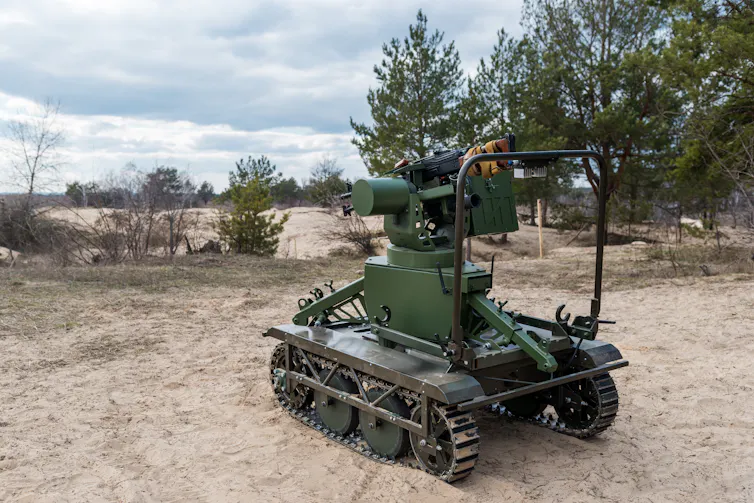
But all this leads to an inevitable question: why would a military want a complex, expensive humanoid when they could use vastly cheaper, rugged, tracked or wheeled drones? In open-field combat, tracked vehicles are absolutely superior. They heave bigger payloads, carry thick ballistic armour, and are far more energy efficient.
However, the nature of conflict is changing – and urban environments play an increasing role in military thinking. Cities are built exclusively for humans. A tracked robot cannot easily climb a vertical fire escape ladder, turn a standard door handle, squeeze through a narrow, debris filled stairwell, or sit in the driver’s seat of a captured supply truck.
dotshock / Shutterstock
A humanoid robot acts as a “drop-in replacement” for a human soldier. If a building is designed for a human to navigate, a humanoid robot can navigate it without requiring custom redesigns or specialised ramps.
This brings us to a profound ethical crossroads. Many of us in the robotics field do not endorse offensive warfare. But these machines have an undeniable utility in defensive scenarios and those concerned with neutralising threats to military personnel and civilians.
Sending a humanoid into a building to rescue hostages, neutralising an active threat such as hostage-takers, or clearing a booby trapped room saves human lives.
Anton_AV / Shutterstock
Dual-use tech
In fact, the modern surge in humanoid robotics was largely kickstarted by the US government’s Darpa Robotics Challenge, which funded bipedal robots specifically to respond to disasters such as the Fukushima nuclear meltdown where human responders could not survive.
The dilemma is that the technology is agnostic to intent. The baseline capabilities required to navigate a ruined building and extract a casualty are the same capabilities needed to enter a building and kill enemy soldiers. If the technology is ready for defence, it is also ready for offensive use.
Perhaps the most alarming aspect of this rapid advancement is how accessible it is.
Unlike nuclear technology or stealth aircraft, modern robotics thrives on open-source frameworks. For example, a military specific software ecosystem (a network of apps and other services that work together) known as ROS-M, along with simulation tools and training datasets, are largely public and shared across global academic communities.
With enough skill, a dedicated adversary can replicate advanced robotic behaviour with relative ease. We can no longer afford to treat humanoid robotics purely as an academic pursuit or a commercial novelty. We need an urgent international conversation about how to control these advances.
Just as we regulate the export of certain microchips and aerospace components, we must begin protecting the software architecture and training pipelines that give these machines their minds. The hardware is walking out of the lab – it is time our policies caught up.
The post “China is exploring humanoid robots for war – but what role could they play?” by Kartikeya Walia, Senior Lecturer, Department of Engineering, Nottingham Trent University was published on 09/14/2026 by theconversation.com