
For the first time, Ukraine has captured a Russian position using only ground robots and aerial drones, reports suggest. In a message posted on social media on April 14, Ukraine’s president Volodymyr Zelensky said: “The occupiers surrendered, and the operation was carried out without infantry and without losses on our side.”
Zelenskyy offered no further details about the operation, but this points to a serious shift in how such robots are used. They are increasingly being deployed in direct combat in war zones. What was once imagined as the future is now a reality.
Until recently, these ground robots were used mainly by the Ukrainian army in support roles, including resupplying frontline positions, evacuating wounded soldiers, and carrying out mining or demining operations in targeted areas.
However, there have been other reported uses of these robots (also known as an unmanned ground vehicles) in combat roles in the war between Russia and Ukraine. In January 2026, Ukrainian forces were reported to have captured three Russian soldiers in Zaporizhzhia using a single ground robot. Footage of the incident, which circulated online, showed the impact of facing a robotic system in combat written on the faces of the captured soldiers.
This has been going on for some time. In March 2025, The Wall Street Journal reported that Ukrainian forces engaged Russian forces near Kharkiv using several ground robots equipped with machine guns. These were deployed from different positions and supported by first-person-view (FPV) attack drones.
Improving with experience
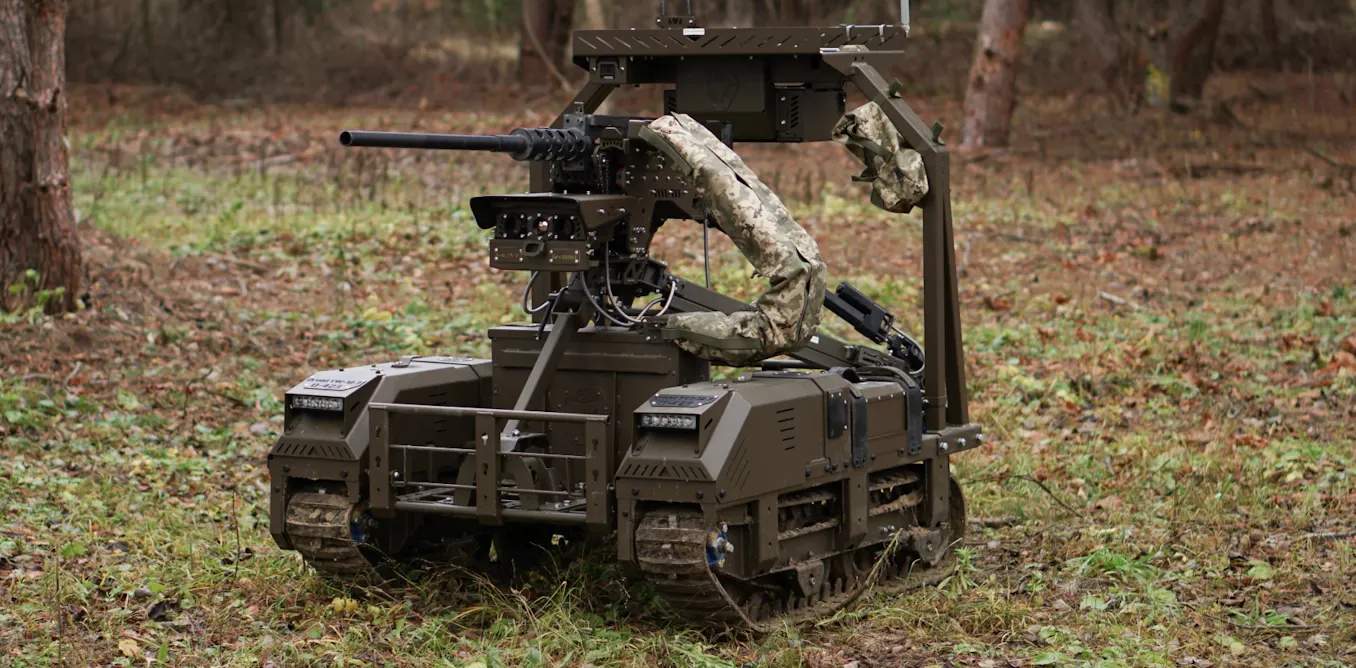
Not much is known about the type of unmanned ground vehicles used by Ukraine. But reports suggest that among the weapons used in most of these attacks is the Droid TW 12.7, developed by Devdroid, a private tech company in Ukraine involved in the manufacture of military robotics.
This robot is armed with a 12.7 mm M2 Browning machine gun, has a firing range of up to roughly one kilometre, and is equipped with night-vision capability. It is remotely operated, rather than fully autonomous, although it can carry out preprogrammed combat tasks.
Devdroid, like most military tech start-ups in Ukraine, appears to hold an advantage in manufacturing these systems and in testing them in active combat conditions on a timely basis. This creates rapid feedback, allowing for quick adjustments and improvements based on battlefield experience.
Maria Senovilla
A coordinated attack, like the ones conducted by Ukraine, involving a group of ground vehicles and swarms of drones, is not just a low-cost way to defend or seize positions but also points to a change in how force is applied on the battlefield.
Such a coordinated “multi-swarm” of killer robots on the ground and in the air would reduce the exposure of human soldiers for the attacking side, while increasing the pressure on those defending both in terms of casualties and the loss of expensive equipment. Such robots are produced locally and are far cheaper to lose than trained soldiers or expensive military hardware, such as tanks.
There are early indications of this effect. In December 2025, near Kostyantynivka, a Ukrainian Droid TW 12.7 is reported to have detected and disrupted a Russian night assault, destroying an MT-LB armoured vehicle in the process. Incidents like this suggest an opportunity to learn with each deployment and to feed that information back in to subsequent operations.
At present, these robots are not fully autonomous. They are remotely operated, with limited automated functions depending on their programmes. Nonetheless, the direction is clear. As production expands, as these robots are tested, and their designs are refined, these weapon systems are likely to become more capable. They are likely to feature increased levels of coordination and a likely increase in autonomy.
Like any battlefield technology, they have limits. Rough terrain can restrict their movement, and they may be vulnerable to jamming. However, the recent history of drone warfare suggests that such weaknesses are unlikely to remain without resolution for long. Design changes, battlefield testing and production cycles are likely to lead to the manufacture of robots that are more capable over time.
No one wants to face a coordinated attack involving swarms of drones and unmanned ground vehicles on the battlefield. Whatever the view anyone may hold, the advantage is shifting towards systems such as the Droid TW 12.7, both now and in future conflicts.
The future is now
The use of these robots raise ethical and legal concerns, including questions of accountability when multiple weapons systems are deployed at once, and issues related to reduced restraint in their use.
In our recent study, we found that existing international laws are insufficient to regulate the development and use of killer robots that may target and kill autonomously. We argue that such weapons pose serious ethical, legal and security risks in the places where they are deployed, often in the global south. For instance, the first recorded use of an autonomous killer robot occurred in Libya in 2020, when an armed group reportedly deployed a Turkish-made Kargu-2 drone that “hunted down” members of the Libyan National Army.
We recommend that humans must remain in control of these weapons, and that clearer human-centred rules are needed to govern the design, testing and deployment of autonomous weapons systems, which include robots.
The unprecedented use of robots to capture an enemy position in Ukraine marks a clear shift in how robots are used on the battlefield. It might already be possible for one or two soldiers to deploy groups of coordinated robots that, together with swarms of drones, attack or defend front lines in the battlefield.
Killer robots are no longer something that exists only in science fiction movies. They are real and here to stay. This shift in the use of robots on the battlefield increases the need for international regulation on the production, testing and use of AI-enabled weapons.
The post “Ukraine’s killer robots show how war is changing” by Ezenwa E. Olumba, Leverhulme Early Career Research Fellow, Aston University was published on 04/27/2026 by theconversation.com