
Industrial manufacturers often struggle with capacity, labor strain, and consistency.
At Korea Filter Engineering, manual palletizing of 10–20 kg (22-44 lb) industrial filter boxes was limiting output, increasing ergonomic risk, and slowing deliveries.
After deploying the Robotiq PE20 with a UR20, the company achieved:
- 30% production increase
- 50% reduction in worker fatigue
- Near 50% reduction in injury-related absences
- Zero workplace incidents since installation
- ROI expected within 2 years
This case study shows how collaborative robot palletizing improves productivity while protecting workers in heavy-load manufacturing environments.
Company overview: Industrial filter manufacturing in South Korea
Founded in 1996 and based in Gimpo, Korea Filter Engineering manufactures industrial filters used in electrical discharge machining (EDM).
- Industry: Industrial filter manufacturing
- Employees: 15
- Daily palletizing load (before automation): ~4 tons
- Box weight: 10–20 kg
With a lean workforce and growing demand, manual palletizing became a production bottleneck.
The challenge: Manual palletizing of heavy boxes
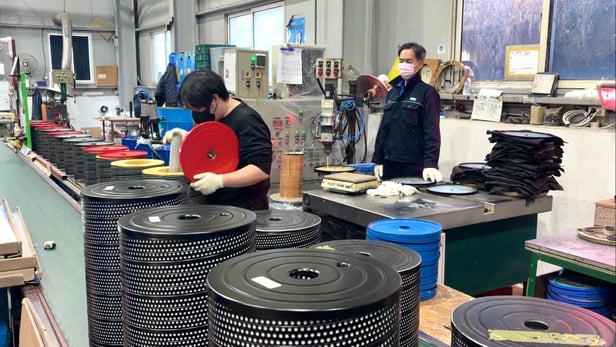
Before automation, workers manually lifted and stacked approximately 4 tons of product per day.
Key issues included:
1. Ergonomic risk and worker fatigue
- Repetitive lifting of 20 kg boxes
- Back, shoulder, and muscle strain
- Aging workforce increasing injury risk
- Fatigue affecting morale and consistency
2. Productivity limitations
- Daily output capped at 200 boxes
- Delays caused by physical strain and absenteeism
- Difficulty maintaining consistent throughput
3. Failed alternatives
Previous lifting aids were tested but operations repeatedly reverted to fully manual palletizing due to complexity or inefficiency.
The company needed a solution that was:
- Compact
- Stable
- Easy to operate
- Safe for human-robot collaboration
- Quick to deploy
The solution: Robotiq Lean Palletizing
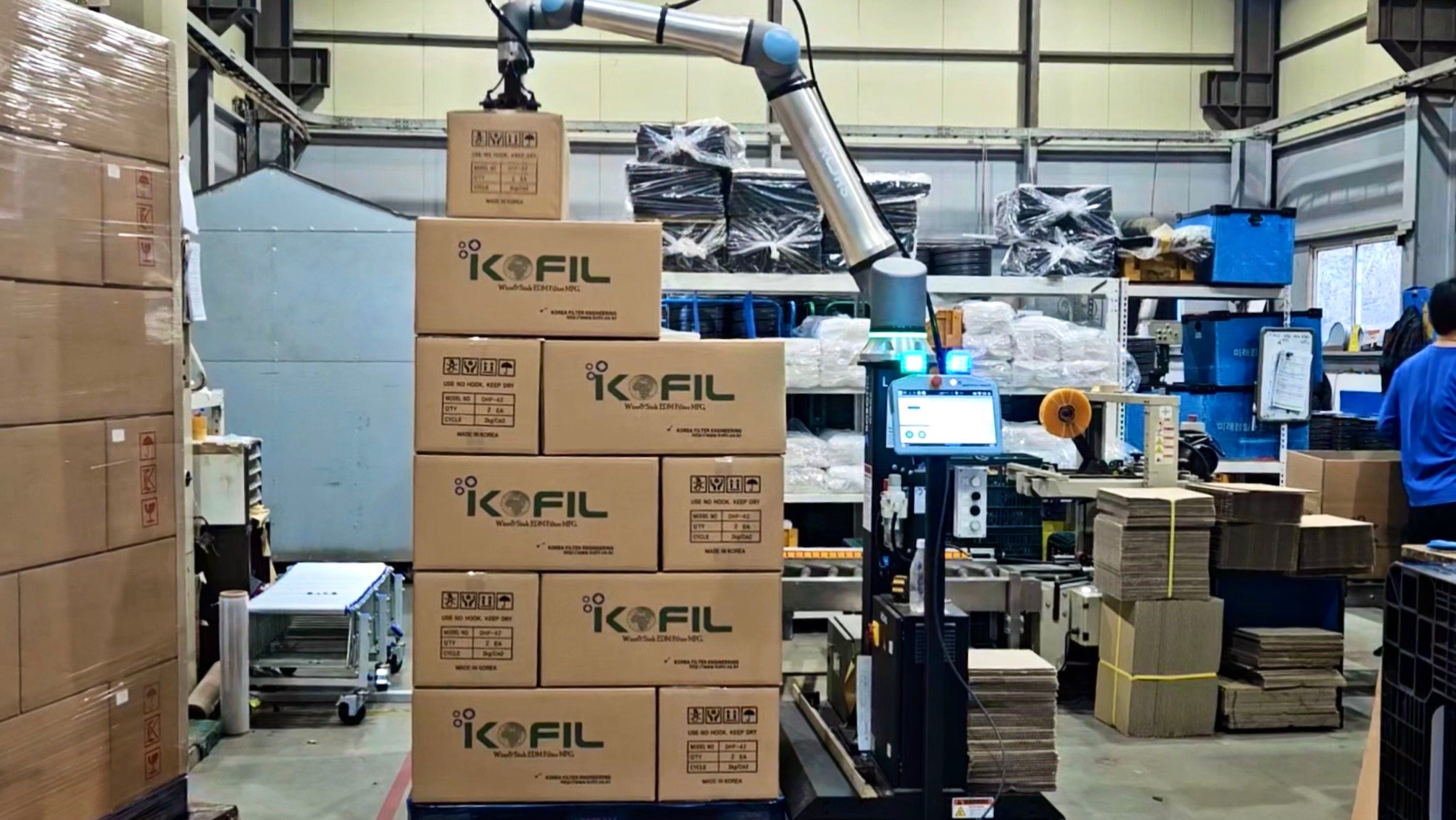
In early 2025, Korea Filter Engineering selected the Robotiq PE20 palletizer integrated with the UR20 collaborative robot.
Why this palletizing system?
- Handles boxes up to 20 kg
- Supports up to 20 SKUs
- Maximum pallet height: 2130 mm (84 in)
- Compact footprint for space-constrained facilities
- Works alongside employees without extensive safety fencing
- Intuitive interface requiring minimal training
Fast deployment timeline
- Early 2025: Evaluation
- March 2025: Quotation
- May 2025: Installation and launch
Minimal layout changes were required. The system integrated seamlessly with the existing conveyor.
Operators were able to learn and run the system within minutes, reducing dependency on specialized robotics expertise.
Results: Measurable gains in productivity and safety
1. 30% production increase
- Output increased from 200 to 250 boxes per day
- Higher throughput without increasing headcount
- Improved delivery reliability
2. Improved worker health and safety
- Injury-related absences nearly halved
- Worker fatigue reduced by more than 50%
- Zero workplace incidents since installation
Young-Hun Yoo, Assistant Manager in Production, shared:
“After using the robot, our bodies are healthier, and we feel less tired—less than half compared to before. We have more energy left for our families after work.”
3. Workforce optimization
- One full-time employee reassigned to higher-value tasks
- Less physical strain, more operational focus
- Stronger team morale
4. Strong financial case
- Expected return on investment within 2 years
- Reduced indirect costs related to injury and absenteeism
- Increased capacity without expanding facility space
Why collaborative robot palletizing works in heavy manufacturing
This project demonstrates key advantages of cobot palletizing systems:
Protects workers from repetitive heavy lifting
Removing 4 tons of daily manual lifting dramatically reduces ergonomic risk.
Increases output without expanding workforce
Automation supplements labor instead of replacing it.
Scales with product variability
The PE20 handles up to 20 SKUs, supporting diverse product lines.
Fits in space-constrained facilities
Compact design makes it viable for small and mid-sized manufacturers.
Enables fast ROI
Measurable productivity and safety improvements accelerate payback.
Woo-Seok Kim, Director of Business, explained the decision:
“We checked many robot systems, but the PE20 was the most stable. Protecting our workers is the most important thing, and the PE20 allows us to do that. That is why it is worth the investment.”
Key takeaways for manufacturers considering automation
If your operation involves:
- Manual palletizing of heavy boxes
- Repetitive lifting causing fatigue or injuries
- Labor shortages or aging workforce challenges
- Limited floor space
- Productivity plateaus due to physical constraints
Collaborative palletizing automation may deliver rapid, measurable impact.
Korea Filter Engineering’s transformation proves that manufacturers do not have to choose between:
- Productivity and safety
- Growth and workforce wellbeing
- Automation and operational stability
With the right palletizing solution, you can achieve all three.
Is Lean Palletizing the right fit for your production line?
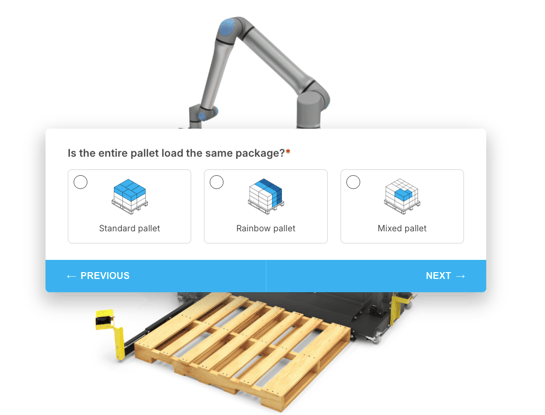
Use Robotiq’s Palletizing Fit Tool to quickly assess whether cobot palletizing makes sense for your operation and what a realistic deployment could look like for your facility. You’ll even get personalized estimates for ROI and payback periods and a 3D simulation of what Lean Palletizing could look like on your factory floor.


The post “Korea Filter Engineering increases production 30% with Robotiq Lean Palletizing” by Zoey Chen was published on 02/19/2026 by blog.robotiq.com