
In the late 1940s and early 1950s, the United States and the Soviet Union were locked in a race for technological and ideological supremacy.
The Cold War was still in its early years and each side was intently focused on the other’s scientific and military progress. The US believed it was firmly in front.
So the Americans were caught almost completely off guard in October 1957, when the Soviet Union successfully launched Sputnik-1, the world’s first ever artificial satellite, into orbit.
Today, the US is locked in competition with a different superpower: China. In recent years, China has given the world some surprise breakthroughs of its own – from advanced hypersonic missiles to cutting-edge computer chips and powerful artificial intelligence (AI) models.
The question is, how did China get there – and what can other countries like Australia learn from it?
Decades in the making
A recent study by the National Bureau of Economic Research (NBER) in the US sought to better understand Chinese innovation by examining about 14 million Chinese patent publications from between 1985 and 2023.
Its findings suggest these modern “Sputnik moments” were not isolated strokes of luck, but were instead decades in the making.
The study noted that Chinese patent activity in critical technology areas (as defined by the US Department of Defense) has been growing.
The number of new patents has steadily increased from fewer than 10,000 annually in the early 2000s to more than 400,000 in 2022.
A related report by the Australian Strategic Policy Institute suggests China now leads globally in 69 of 74 critical and emerging technology domains.
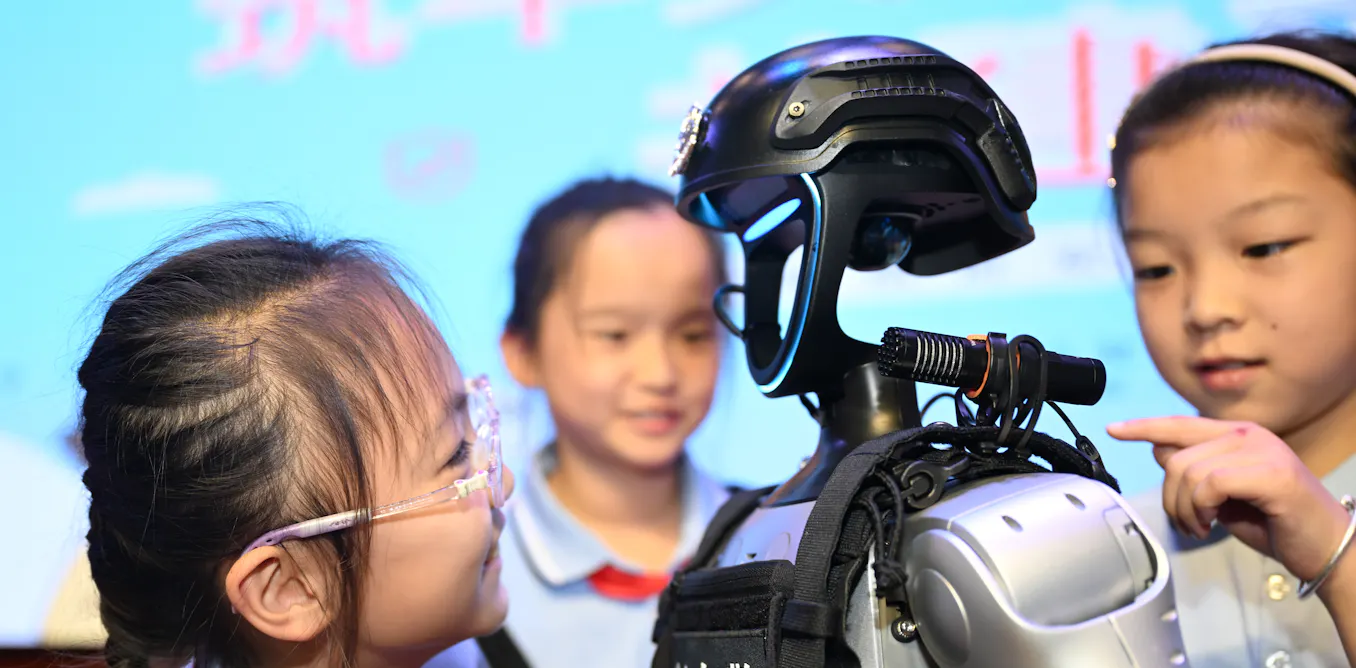
CFOTO/Future Publishing via Getty Images
Quality and quantity
When looking more closely at the recent NBER study, a few interesting insights emerge.
First, it reveals China hasn’t just been filing an increasing number of low-quality patent applications. On a measure that tracks whether novel ideas influence later inventions, Chinese patents steadily gained ground relative to US patents.
Second, it hasn’t just been a few “national champion” organisations driving China’s patenting activity. Quite the opposite.
The ten largest owners of critical-technology patents only held 4% of all Chinese patents in 2022. That’s markedly different to the US, where the ten largest owners held 20% of all patents.
And there are big differences on a third point, too – the role of universities. While the private sector accounts for 58% of China’s critical-technology patents, 27% of patents originate from Chinese universities.
That’s in stark contrast to the US, where universities account for only 3% of critical-technology patents.
The role of public research
History suggests that this pattern may not be unique to China. In her 2013 book, The Entrepreneurial State, US-Italian economist Mariana Mazzucato challenges the myth that individual entrepreneurs and firms develop major breakthroughs on their own.

Paul Sakuma/AP
She argues many technological breakthroughs in the US depended on the long-term accumulation of inventions and capabilities across various actors. And importantly, that publicly funded research often also played a major role.
For example, drawing on the iPhone as a breakthrough product, Mazzucato shows that many of the technologies that made the iPhone possible – from touchscreens to GPS and even its voice assistant Siri – had been developed across different, often publicly funded, research institutions before the iPhone was even conceived.
How does Australia compare?
Australia has had a strong track record of invention and scientific discovery in the past. But we’re increasingly struggling to keep pace with the world’s technological leaders.
Australia does still punch above its economic weight in some specific critical technology areas.
For instance, since 2000, Australia accounts for almost 9% of patents in critical-metals refinement for batteries. Australia also ranks 12th globally in the number of quantum-computing patents.
And Australia has had some big innovation success stories in the past. A form of solar cell developed at UNSW in the 1980s now powers more than 90% of new solar panels around the world.
The wireless local area network (WLAN) technology that made modern wifi fast and reliable was also developed here, by the publicly funded CSIRO.
A troubling trajectory
However, Australia’s current trajectory in technology development is somewhat concerning.
Relative to the size of its economy, Australia’s spending on research and development has fallen from 2.24% of gross domestic product in 2008–09 to 1.69% in 2023–24.
Simply increasing spending on research and development may not be enough. New inventions and capabilities also need businesses with the people, expertise and resources to absorb them and develop them further.
Here, Australia appears comparatively weak. Australian businesses employ only around 3 researchers per 1,000 employees, compared with an OECD average of 6.5.
This suggests Australia might have less capacity to turn technological breakthroughs into commercially viable products and services compared with the rest of the world.
Lessons for other countries
This doesn’t mean Australia or other middle powers need to invent and build every critical technology domestically to benefit.
Wireless LAN technology generated around A$430 million in licensing revenue. It is also embedded in more than 15 billion devices globally. This is despite Australia never becoming a dominant producer of wifi hardware.
One key takeaway from China’s innovation success is that by the time a technological breakthrough becomes visible globally, the domestic capabilities behind it may have been accumulating for decades.
Trying to develop them only when they suddenly become critical may be too late.
The post “China’s AI and tech breakthroughs are built on decades of work. Here’s what other nations can learn” by Frederik von Briel, Associate Professor in Strategy and Entrepreneurship, The University of Queensland was published on 08/27/2026 by theconversation.com