
Day (After Day) in the Life of the Useless by Will O’Mahony is a firecracker comedy, exquisitely handled in its premier production for Black Swan State Theatre Company.
The play opens with a tableau of Pete (Will O’Mahony) standing atop a cliff looking across an abyss to a backdrop depicting a painting of an untamed landscape.
The scene is reminiscent of the 19th century painter Caspar David Friedrich’s iconic work Wanderer Above the Sea of Fog. But this nod to Romanticism falls comedically short. Pete is no Romantic hero.
Just days before his wedding, Pete’s fiancée (Tess Bowers) dumps him for a new lover, and in her parting shot calls him a robot. Turning to artificial intelligence for guidance, Pete gets a reply in 1.49 seconds: “The best revenge is living well”.
If only it were that easy. Things spin out of control like a Catherine wheel as Pete attempts to rebuild his life. What follows is a spectacular series of hilarious missteps as Pete soldiers on in an increasingly unrecognisable world.
Is everyone a robot?
This everyman journey is structured as 35 short, carefully-crafted chapters, with dialogue singing off the page.
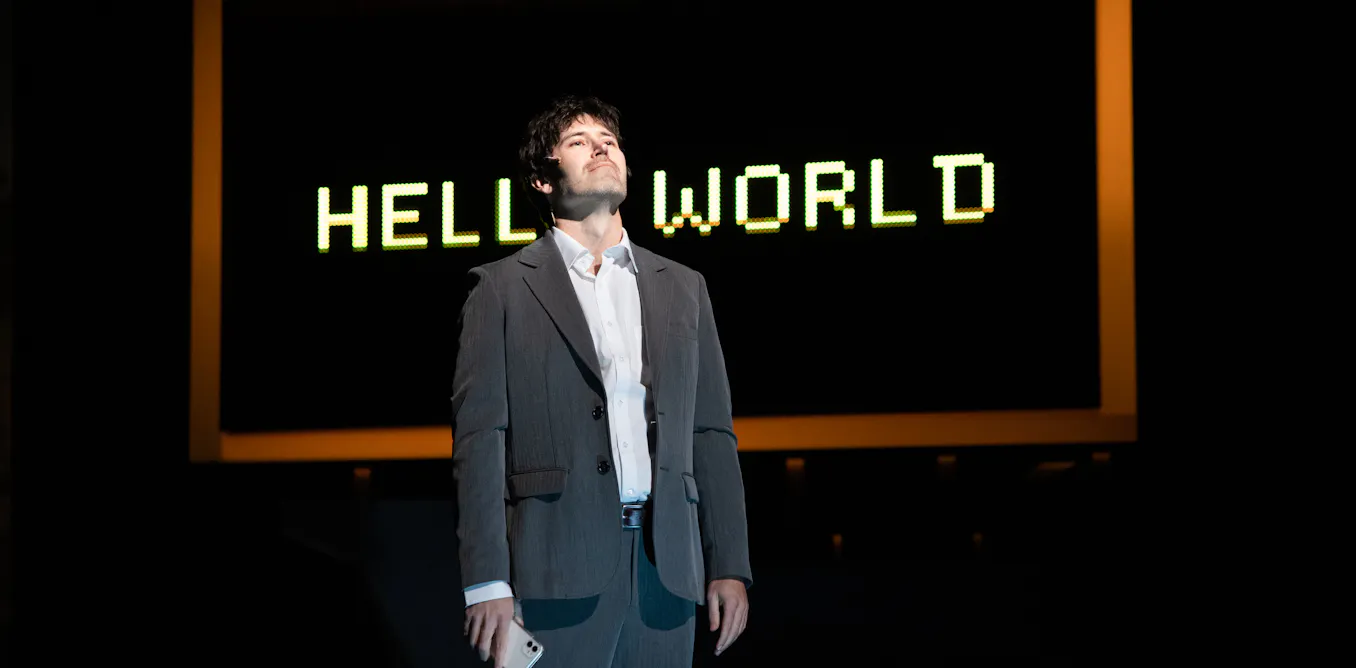
Each has a title taken from a seemingly random piece of dialogue from that chapter, and projected using bright yellow LED lights on a variable message sign, like the kind you see pop-up on the roadside when there’s a traffic warning.
This digital signage is a clever device; it allows the audience to reorient as the narrative hurtles at an unrelenting pace into new territory.
Daniel J Grant
The signs also allow us a breather as the absurdity of Pete’s predicament intensifies. He loses his job, his new girlfriend of two weeks gives him the flick, and he keeps getting caught up in dodgy schemes to try and make money.
The world has become alarmingly weird and people are behaving strangely. Pete suspects they might actually be robots.
Leaning into the unknown
O’Mahony has written a dark comedy with its finger firmly on the pulse of our times.
Urgent questions surge below the surface of the play’s anarchic silliness: how can we live in a world increasingly infiltrated by AI? Who can we trust? Is authenticity as we know it redundant? Are we redundant? Is there a moral compass to guide us? Are relationships transactional? And as we stand on the precipice, staring across the abyss to the new era of AI, what will it mean to be human?

Daniel J Grant
The play provides no trite answers to the existential questions it poses. This is not a message play, but a poetic response. It eschews black and white certainty for ambiguity and the unknown.
O’Mahony nudges us in this direction through the inclusion of verse from Emily Dickinson’s poem I Felt a Funeral, in My Brain. The poem’s closing lines pop up throughout the play, spoken by several characters, and even sung as a lullaby: “And I dropped down, and down-/And hit a World, at every plunge,/And Finished knowing-then-”.
This final “then” hanging precariously at the end of the poem perfectly captures Pete’s predicament, caught in world that won’t keep still, and is in a constant state of becoming.
It also captures the structure of the play, which moves restlessly from scene to scene, keeping us on the edge of our seats wondering what comes next.
Cohesive direction and design
That this play is an actor’s vehicle comes as no surprise given O’Mahony is an accomplished actor. As Pete, he does not miss a beat. It is a tour de force performance supported by a superb ensemble.
Tess Bowers, Nathaniel Langworthy, Steve Le Marquand and Catherine Moore play all the other characters (I lost count of how many). They manage insanely quick changes, and land fully-formed in every scene as well-defined characters.

Daniel J Grant
At the final bows, the person sitting next to me commented: “Were there only four actors?” This was comedic acting at its finest, detailed and controlled.
Instrumental in conveying character is Rhiannon Walker’s bold, insightful costume design, which provided clarity amid the production’s frenetic pace, short scenes and multiple characters. When things start to fray at the edges, subtle details such as mismatched shoes or a missing sleeve are delicious.
Director Adam Mitchell creates a flow and rhythm that elevates the play and performances. His masterful direction – alongside sound design (Ash Gibson Greig), lighting (Mark Haslam), and sparse set design (Fiona Bruce) with carefully curated set-features – allow the actors space to tell the story.
All elements are in lockstep, working together to hold the script’s free-ranging expansiveness. It brings to mind lines from another Emily Dickinson poem: “It is enough, the freight should be/Proportioned to the groove”.
From lights up to the production’s satisfying conclusion, Day (After Day) in the Life of the Useless is seriously funny and surprisingly moving. And if the post-show buzz on opening night was anything to go by, it will be a bit of a thought worm for audiences.
Day (After Day) in the Life of the Useless is showing at the Heath Ledger Theatre until September 20.
The post “Is everyone a robot? Will O’Mahony’s new play is a sharp, funny plunge into our AI world” by Helen Trenos, Lecturer (Theatre & Creative Arts), Curtin University was published on 09/04/2026 by theconversation.com