
Innovation is one of the most celebrated yet misunderstood ideas of our time. It is invoked in policy speeches, corporate strategy decks and university mission statements. But strip away the buzzword and what remains?
In The Shortest History of Innovation, economist and federal MP Andrew Leigh offers an accessible, wide-ranging answer. Sweeping across millennia, from the wheel to artificial intelligence, Leigh argues three forces underpin most innovation: tinkering, teamwork and trade.
Review: The Shortest History of Innovation – Andrew Leigh (Black Inc.)
The alliteration is elegant. More importantly, however, it captures much of what innovation scholars have long observed: ideas become valuable not through inspiration alone, but through experimentation, collaboration and exchange.
Leigh’s definition aligns broadly with the OECD’s Oslo Manual, the global standard for measuring innovation. Innovation is not invention per se, but the introduction of new products, processes or organisational methods that create value.
The three ‘T’s
Leigh rightly pushes back against the myth of the lone genius. Breakthrough ideas are only the beginning. It is the grind of refinement, tinkering at the “adjacent possible”, that turns creative sparks into useful technologies.
The emphasis on teamwork is particularly welcome. Innovation requires different disciplines to work together, different organisations to partner with each other and engage with stakeholders across supply chains. That includes their customers.
The Human Genome Project, large scale research centres, and modern examples of business, government and society working together to change things all demonstrate that innovation is inherently social.
As part of an ecosystem to foster innovation, this triad works. But it is incomplete without a fourth, sometimes forgotten force: infrastructure.
Throughout the book, Leigh offers compelling illustrations of enabling conditions. The wheel did not transform transport until roads were built. The light bulb required electrification networks. Coal powered the Industrial Revolution.
Computer chips designed for video game graphics became the ones that power artificial intelligence. Universities, introduced in medieval Europe, became long-term institutional platforms for knowledge creation.
Sir Henry Churchill Maxwell Lyte (1848-1940) via Wikimedia Commons, CC BY
These are not footnotes to innovation; they are preconditions. Innovation flourishes when these examples of physical, intellectual and institutional infrastructure stabilise expectations and lower the cost of coordinating.
Britain’s 18th-century parliamentary system, an abundance of artisans, and access to coal created a fertile institutional environment.
Leigh frequently gestures to these enablers. But they are a central part of any innovation ecosystem. Innovation is rarely the outcome of individual brilliance alone. It emerges as a property of dense, well-connected and supported systems that allow ideas to be tested, scaled and diffused.
Leigh argues that across history, place matters – and this matches contemporary evidence. Living near centres of learning, industrial clusters, or technology hubs increases exposure to ideas and collaborators.
Acceleration and recombination
One of the most compelling threads in the book is the idea of “recombination” – innovations build on prior innovations. Mathematics developed in Persia later enabled European scientific advances. Precision machine tools in the 19th century unlocked new industries. As enabling technologies accumulate, the pace of innovation accelerates.
This virtuous spiral means that the more ideas in circulation, the greater the opportunities for recombination. This resonates strongly with contemporary innovation theory: we are increasingly remixing rather than inventing from scratch. Digital platforms, open data and interdisciplinary research intensify this dynamic.
‘Creative destruction’
But acceleration is not neutral. It amplifies both benefits and risks.
Leigh acknowledges innovation is disruptive, echoing economist Joseph Schumpeter’s “creative destruction”. He notes new technologies often displace old industries. Netflix destroyed video stores – and then came for Hollywood.
Process innovation, from Frederick Taylor’s re-engineering of work to Toyota’s continuous improvement systems, reshaped labour itself.
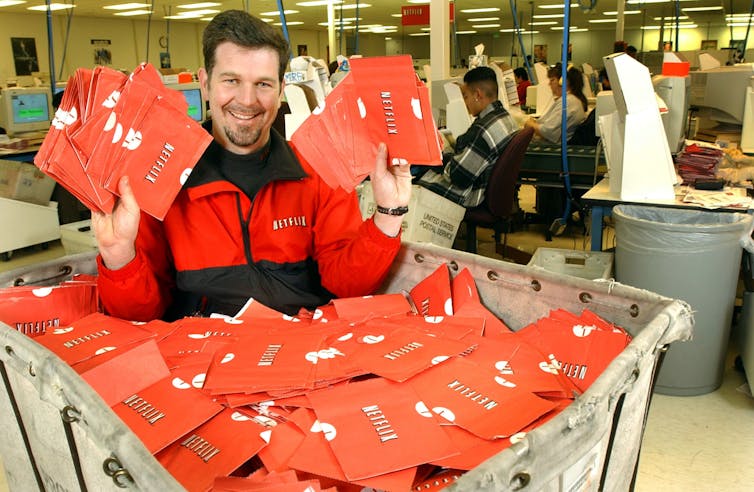
Justin Sullivan/Stringer via Getty Images
Innovation’s dark shadow
Innovation improves humanity’s capacity for progress and harm. These darker sides are present in the book, but not laboured. Gunpowder and the Haber process fuelled war. Coal warms the planet. The atomic bomb altered geopolitics. Marie Curie died from radiation exposure. Patents have both protected and restricted life-saving technologies.

Jack W. Aeby, July 16, 1945, Civilian worker at Los Alamos laboratory, working under the aegis of the Manhattan Project., Public domain, via Wikimedia Commons
From an ecosystem perspective, these tensions matter. Innovation is not inherently good. Incentives, governance and ethical guardrails shape it. The question is not whether societies innovate, but how they channel innovation.
The book’s overall tone, however, is optimistic. Innovation has extended life expectancy, improved nutrition, advanced medicine and raised living standards. It is credited with driving between one-third and two-thirds of global economic growth.
Government, openness and the public good
Given Leigh’s background as a sitting member of parliament, the role of government features prominently. Wartime research, public institutions and state-led programs are presented as catalytic forces. Public dollars, he argues, are best spent creating environments that encourage experimentation.

This is largely persuasive. Public investment has historically underwritten foundational technologies. Yet there is a delicate balance between public leadership and market dynamism.
Innovation ecosystems thrive not merely because governments fund them, but because institutions align: education systems, research organisations, firms, financiers and regulatory frameworks.
The book also highlights the importance of open innovation. Some inventors, such as Marie Curie and Tim Berners-Lee, chose not to patent their discoveries. Left in the public domain, ideas can spread faster and further. Yet organisations must also recoup investments.
This tension between openness and appropriation remains one of the central policy challenges of our time.
Serendipity, diversity and inequality
Leigh repeatedly returns to luck and serendipity. Leonardo da Vinci’s trajectory depended on patronage, timing and freedom to experiment. Post-it notes and friction matches emerged from unexpected discoveries.
He also acknowledges that history has not been kind to diversity. Innovation has disproportionately reflected the opportunities available to wealthy men, with notable but limited exceptions among women pioneers and bottom-of-the-pyramid innovators.
A seismic shift?
The final chapters touch on artificial intelligence. Yet one might ask whether AI is treated as simply another innovation in a long line, or as a structural transformation reshaping every domain of human endeavour.
If the accumulation of enabling technologies accelerates innovation, AI may represent not just a new tool but a meta-technology that alters the innovation process itself.
That question lingers.
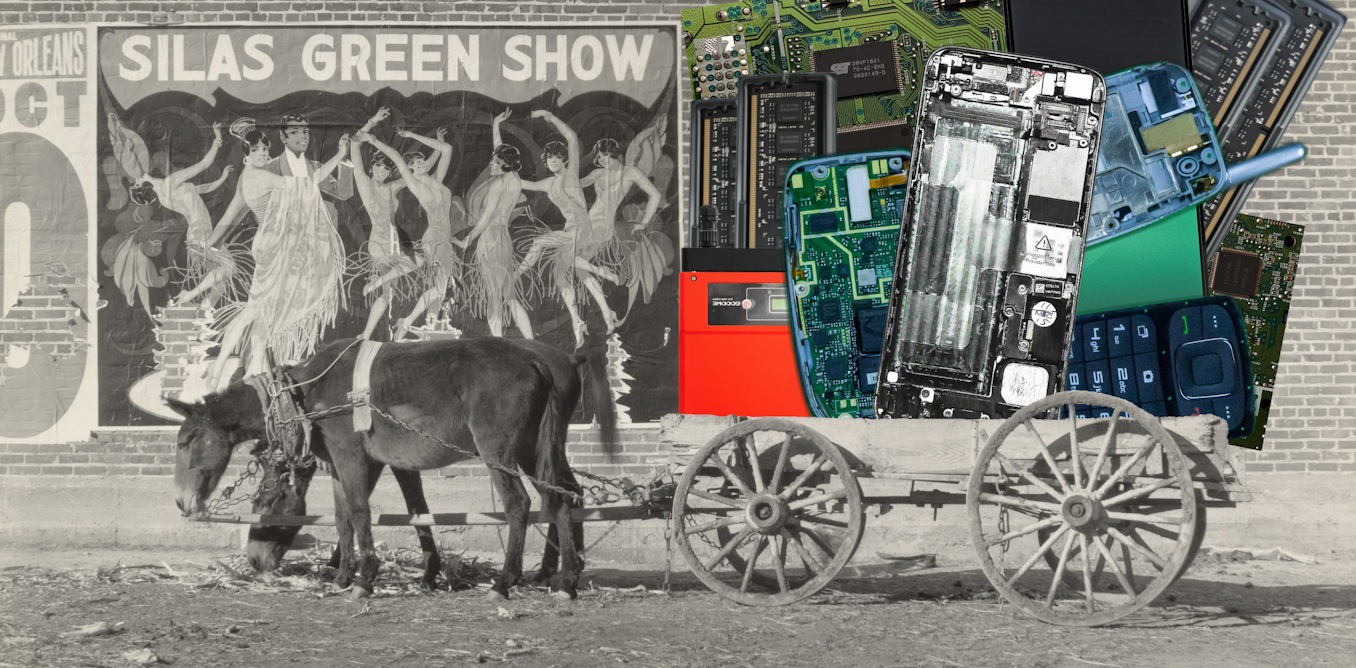
The post “Andrew Leigh maps the drivers of history’s big breakthroughs — and why they still matter” by Martie-Louise Verreynne, Professor in Innovation and Associate Dean (Research), The University of Queensland was published on 03/08/2026 by theconversation.com