
For us linguists, the flurry of “word of the year” announcements from dictionaries and publishers is a holiday tradition as anticipated as mince pies. The words of the year aren’t just a fun peek into new slang and language changes, they also tell us quite a bit about the worries, trends and obsessions of the English-speaking world.
And this year’s list has one clear theme. In 2025, artificial intelligence (AI) played a huge role in our offices, social media feeds, music and film, and now – dictionaries.
One of the first announcements this year was Collins Dictionary, who selected “vibe coding” as their word of the year. Vibe coding refers to using AI tools to generate code rather than manually coding software programs.
When I first heard this, my initial reaction was that this is a very niche phrase, not in most people’s vocabulary. However, if we look back to Cambridge Dictionary’s selection for 2023 – which was “hallucinate”, referring to the false or nonsense responses generated by AI models – many people felt the same. Now, we regularly refer to the hallucinogenic properties of AI output, rolling our eyes at some of the answers it provides. Language can and does change, and quickly.
Read more:
What are AI hallucinations? Why AIs sometimes make things up
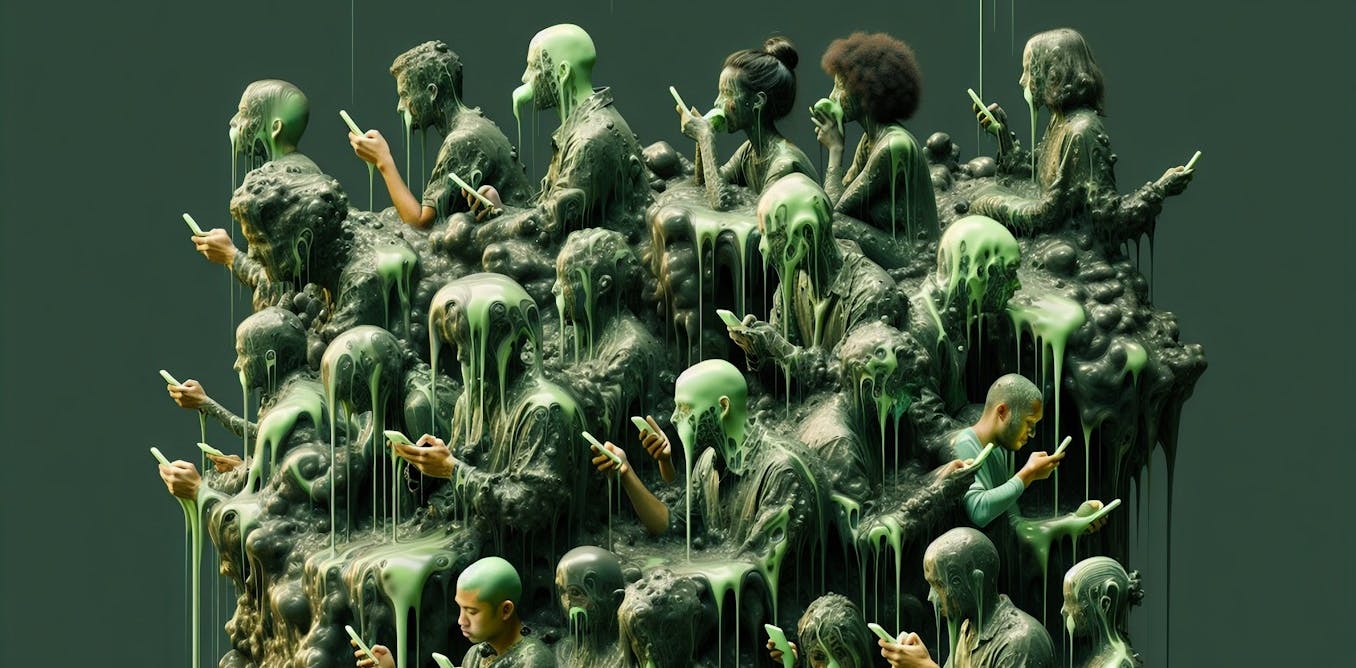
Such output can sometimes be described as AI slop, “low-quality content created by generative AI, often containing errors, and not requested by the user” – Macquarie Dictionary’s 2025 word of the year. The Economist and Merriam-Webster also went with “slop”, suggesting that this content, however unappealing, is a significant part of our adoption of this new technology.
“Clanker” is another word which made many of the shortlists this year, being used to as a derogatory word to describe an AI source.
Feeling like you’ve had enough of AI? For many, the opposite may be true: for its 2025 word of the year, Cambridge Dictionary chose “parasocial”, expanding the definition to account for people’s relationships with AI companions and chatbots.
Another term that reflects the AI-driven battle over authenticity is “glazing”, which appeared on Collins Dictionary’s shortlist. Defined as “to praise or flatter excessively, often undeservedly”, glazing is something that will be recognisable to anyone who’s ever asked ChatGPT to help them make a decision (OpenAI rolled back a ChatGPT update in early 2025 due to sycophancy in the chatbot).
Choosing the year’s top word
Despite what you might imagine, these words are not selected by lexicographers gathering in a secret conclave. Significant time is spent on tracking the usage of words throughout the year before making decisions on contenders.
Cambridge Dictionary tracks searches on their online dictionary and through Google on a monthly basis. Dictionary.com expands on search engine results to include news headlines and social media trends. Oxford University Press maintains a massive database of language, known as the Oxford Monitor Corpus of English, which is continually updated with automatic feeds from online media. This amounts to 150 million words per month and is a rich source of online trends for the Oxford team.
The lexicographers then come up with shortlists of words. Readers can also have their say, as many of the publishers, including Oxford University Press and Macquarie, put their choices to the public vote. The words with the most votes are then officially crowned as word of the year.
PeopleImages/Shutterstock
Traditionalists may argue that many of these words are in fact multiple words. But as long as they represent a “single unit of meaning”, they are considered worthy winners. Nor are they always new words. Neologisms can be a new or expanded meaning of a word which already has a lengthy history (see “parasocial” – feeling a connection with someone we don’t actually know in person – which applies to Beatlemania and Taylor Swift fans as much as AI).
Internet culture continues to provide rich pickings for words of the year. “Rage bait” was Oxford Dictionary’s selection. This involves social media content intended to manipulate users into responding negatively to a post or attacking previous responses. The posts and subsequent comments appeal to our emotions, but not in a good way. Naming this behaviour shows our increasing awareness of such manipulative techniques and hopefully, the start of many people refusing to engage with online negativity.
Read more:
Rage bait: the psychology behind social media’s angriest posts
“Memeify”, the action of creating memes, even made Cambridge’s shortlist for 2025. My personal favourite word of the year in 2025 was driven by basketball-related memes, namely “67”, which was Dictionary.com’s choice.
This contribution welcomes generation alpha to the linguistics table. Traditionally, new slang terms would have been first used by older teenagers as they established friendships and their identities outside their families. But this year shows that our youngest generation group is seamlessly navigating online content, and in doing so, is already influencing language use.
The post “AI dominates 2025’s words of the year” by Gail Flanagan, PhD Candidate, Applied Linguistics, University of Limerick was published on 12/16/2025 by theconversation.com