
In the past few days your social media feeds may have been full of videos of humanoid robots sprinting, jumping and performing various incredible (and not so incredible) feats.
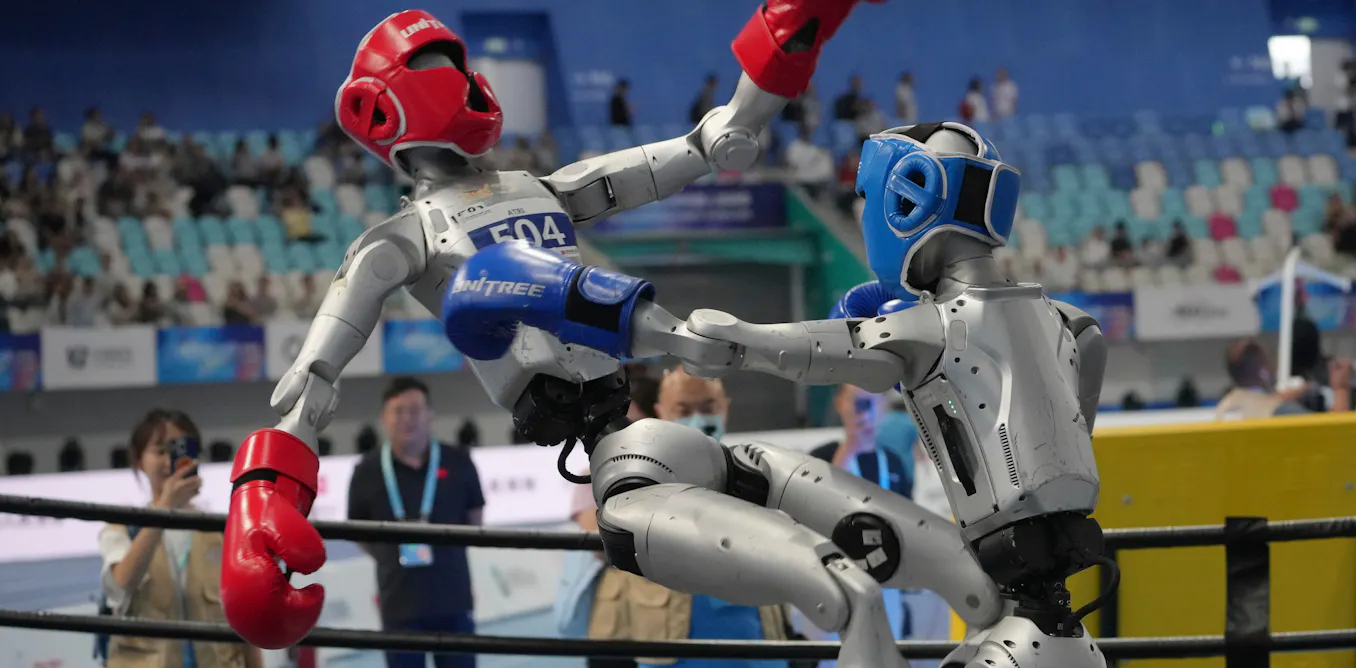
This is because the second World Humanoid Robot Games have just finished in Beijing.
It featured many incredible sights, but some of the more mundane events offered more insight into how this technology will eventually help humans.
Robots are now faster than people
Commonly referred to as the robot Olympics, this event started last year, when about 500 robots showed off their abilities in 25 events. This year’s version featured more than 2,000 robots competing in 50 events.
The robots that enter must be so-called humanoid robots: under the games’ rules they need a torso, two arms and two legs, an onboard power source and no trailing cables.
Half of the events are direct copies of the human Olympics and Paralympics: track and field, weightlifting, soccer and boxing.
Just like in the human Olympics, the crowd-pleaser was the 100 metre sprint. This year, two robots beat Usain Bolt’s world record of 9.58 seconds, with the fastest clocking 9.39 seconds.
The same story played out in the 400m, when one robot finished in 39.7 seconds – the current men’s world record is 43.03 and women’s is 47.60.
Impressive stuff. But it’s the other 25 events, which are not like the human Olympics and Paralympics, that paint a more interesting picture.
A new kind of competition
The list of non-sporting events is very telling in how humanoid robotics is developing, or how manufacturers of the robots hope it will develop.
That list of events includes book sorting, garden management, bricklaying and possibly the most exciting event: tweezer bean picking.
These are clearly skills based on real-world scenarios outside the sporting arena, and that is what makes these games so interesting.
Getting a robot to run 100m in a straight line very quickly is a great engineering achievement. Developing a robot to jump 2.8 metres into the air from a standing position is also impressive.
But how about a humanoid that can make you a cup of tea in your own kitchen or clean up the cat’s kitty litter tray properly? Such tasks are currently science fiction in the world of robotics. Sending people to the Moon is more straightforward than developing a humanoid robot that can reliably load and unload a dishwasher.
Most people can easily use a dishwasher but if you break down what you are actually doing when carrying out this everyday task, it is actually extremely complicated. It involves amazing sensing, sophisticated planning and great object manipulation, from plates, to teaspoons to maybe even pots and pans (if you are that kind of all-in dishwasher person).
Humans don’t have to think too hard about these things but this is exactly what robots really struggle with because they have a very limited ability to make fast decisions to cope with a world that changes very quickly and unpredictably.
A plate may slip in its hand, meaning it needs to adjust its grip. A cluttered dishwasher is a minefield of failure opportunities.
For a humanoid robot to reliably complete a complex task, it typically needs to first see the objects that it needs to interact with. This alone is incredibly difficult. Lighting conditions that we are not troubled by are still difficult for robots.
If they see the object they need to pick up, a robot then needs to work out how to pick it up, which might involve judging both large and small forces. Again, this is very hard for a robot to do.
It needs to work out where and how to move the object, maybe put it down and then plan the next move. The sequence of actions is very challenging to get right every time, given each is difficult in its own right.
And the hardest part? A robot must recognise when something has not gone according to plan and then work out what to do next.
It is therefore the non-sporting events at the Humanoid Robot Games that are the true test of how well humanoids are progressing to being a useful tool. This year’s games have been exposing exactly these sorts of difficulties.
Some of the most revealing challenges are the small imperfections of the real world: a cable at the wrong angle or an object slightly out of reach or a package that shifts unexpectedly. Robots need to recognise these problems and recover without a human stepping in.
Achmad Ibrahim/AP Photo
The future for humans – and robots
It is easy to see why these competitions are useful to technology companies.
A spectacular sports demonstration can show what a robot can do when everything is easy and goes right. And real-world competitions based on everyday tasks can expose what happens when things go wrong.
These types of competitions also reveal an important truth about the current humanoid robot boom: there is still a very long way to go until we might see a humanoid robot in our homes or assisting us with day-to-day tasks. But the vast sums of money now being invested means maybe that day is closer than we think.
Read more:
Humanoid home robots are on the market – but do we really want them?
A useful future humanoid probably won’t spend much time sprinting or doing martial arts but instead might help unload trucks, stock supermarket shelves, work in dangerous environments or help an older person remain independent at home.
And maybe one day, it might also do something as mundane as emptying your dishwasher.
The post “The ‘robot Olympics’ were spectacular – but will this technology end up helping humans?” by Jonathan Roberts, Professor in Robotics, Queensland University of Technology was published on 08/26/2026 by theconversation.com