
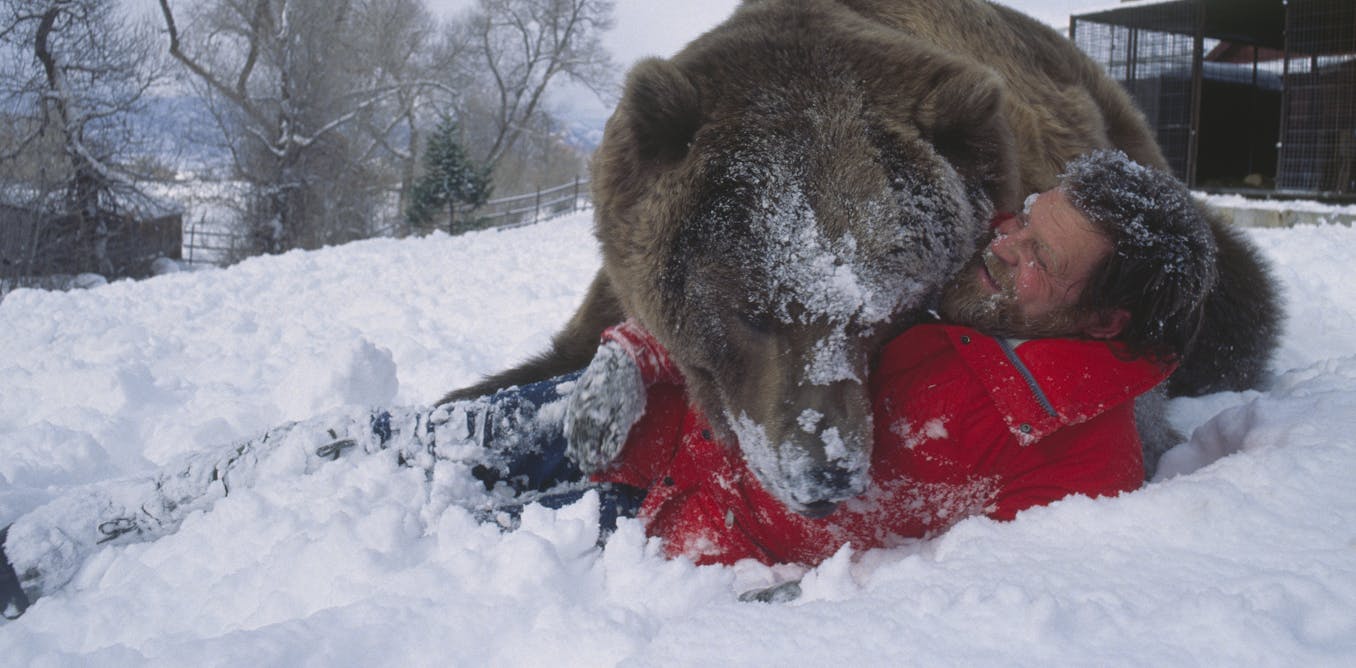
There is a long and storied history of nonhuman actors, from Luke, the dog of silent star Roscoe “Fatty” Arbuckle, to the collies cast in the role of Lassie in film and on television. Bart the Bear racked up over 20 film and TV credits in the 1980s and 1990s, while countless horses have supported period dramas that now saturate streaming services.
But business has not been as good as it used to be for the animal trainers who specialize in renting creatures of all kinds to film and TV productions.
According to The Hollywood Reporter, it’s a trend that’s been building for at least 25 years, and it’s largely due to a mix of activism and technological advances, which I’ve observed in my studies of animals on screen.
Fewer roles to go around
Hollywood’s adoption of visual effects – also referred to as computer generated imagery, or CGI – has had an outsized role in putting many animal actors out of work. Ever since “Jurassic Park” (1993) dared to comingle CGI dinosaurs with human actors, more and more digital animals have appeared alongside humans on screen.
Other factors have accelerated the trend.
The COVID-19 pandemic, the 2023 Hollywood actors and writers strikes and a recent dip in the number of new TV series being greenlit have meant fewer productions and fewer roles to go around, whether they’re written for humans or animals.
But even before these recent events, there were calls for Hollywood to radically reduce its dependence on animal actors.
In 2012, The Hollywood Reporter – the same trade magazine that recently lamented a downturn in animal rentals – published an exposé cataloging incidents in which animals died, were injured or were put at grievous risk on sets. These productions nonetheless went on to carry the famous “No Animals Were Harmed” credit awarded by the American Humane Association, despite the fact that, well, animals were harmed. American Humane maintained that the incidents were tragic but not the result of negligence.
In 2016, PETA released the results of undercover investigations documenting substandard living conditions and untreated medical conditions at Birds & Animals Unlimited, which operates animal training facilities for film and television. In 2024, the organization detailed neglect of animals in the care of Atlanta Film Animals. Both companies denied the allegations.
There are, of course, any number of ways to minimize or avoid using actual animals in film and TV altogether.
“The Rise of the Planet of the Apes” and its sequels have used motion-capture, with humans performing the movements of characters later rendered as chimpanzees, gorillas, bonobos and orangutans.
For Ang Lee’s 2012 production “Life of Pi,” visual effects artists created thousands of virtual animals, while director Darren Aronofsky opted for completely digital animals, supplemented by some practical props, in 2014’s “Noah.”
Bucking high-tech trends, the 2025 horror film “Primate” went old school without reverting to real animals, deploying a movement artist in a costume and prosthetics to play a murderously rabid chimp.
Can CGI numb viewers to animal violence?
What do digital animals, these bestial avatars, make possible?
Undoubtedly, there are trainers who care deeply for their charges and uphold best practices in animal husbandry. But it stands to reason that the fewer captive animals, the better, and recent advances in AI have made visual effects and CGI even more realistic and easier to model.
However, substituting flesh-and-blood animals with those made of pixels seems to have created a canvas for unfettered abuse. Consider the brutal violence of the “Planet of the Apes” reboots, which include hand-to-hand combat, branding and a torturous crucifixion scene.
In the past, the fact that the animals on set were real sometimes curbed filmmakers’ most savage impulses; violence was implied or took place off-screen in family fare like “The Yearling” (1946) and “Old Yeller” (1957). At the same time, camera tricks and props have been used to create scenes of animal cruelty in many films, from “American Psycho” (2000) to “John Wick” (2014).
While the effects of violent media on viewers are notoriously hard to study, some evidence suggests that some audiences can become desensitized to the real-world consequences of unhealthy and violent content. It’s easy to see how this desensitization could extend to watching cruelty toward animals on screen.
Viewers can still sniff out the virtual
A hybrid approach to portraying animals on screen seems to have taken hold, using what one scholar has called – in a reference to on-screen dogs – “composite canine performances.”
The team behind the 2025 version of “Superman,” for example, sought to create a realistic dog, right down to each scruffy patch of fur. But they needed it to defy gravity and other laws of physics. So they incorporated just enough live animal in preproduction to animate a mostly CGI creature, with director James Gunn’s own dog serving as the “model,” or “reference,” for the superdog, Krypto.
This technique recalls the methods of Disney animators who were stumped by the challenge of creating the characters for “Bambi” (1942). So they studied animal anatomy, photographed deer in the wild and sketched animals brought into the studio in order to better capture their movements on paper.
But when it comes to live-action films grounded in everyday life, there’s still work on set for real animals. For one, it’s still usually cheaper to deploy the real thing. Moreover, most of the virtual animals on screen simply don’t look realistic enough to allow for the full suspension of disbelief that makes cinema magic.
That’s why in the 2025 adaptation of Helen MacDonald’s memoir, “H Is for Hawk,” filmmakers reportedly employed five goshawks to portray Mabel, the bird adopted by Helen (Claire Foy). And it’s why Academy Award-nominee “Marty Supreme” featured an entire menagerie of live animals, including a horse, a camel, an armadillo, a dog, a rabbit and even a ping-pong playing sea lion. Yes, the sea lion in the scene was real, but the ball wasn’t.
Future opportunities for trainers and their charges appear to rest on just how good visual effects can get. For some animal activists – not to mention the animals that have no say in their work – that day can’t come soon enough.
Moviegoers and animal advocates, meanwhile, might hope for a middle ground: a future in which only ethically treated animals continue to get to appear on the screen.
The post “Do animals have a future on Hollywood sets?” by Cynthia Chris, Professor of Media Studies, City University of New York was published on 02/19/2026 by theconversation.com