
Much is being said about the wonders of artificial intelligence (AI) and how it is the new frontier. And while it provides amazing possibilities in fields like medicine, academics are debating its advantages for university students. Peet van Aardt researches student writing and presents academic writing workshops at the University of the Free State Writing Centre, helping students to build clear arguments, summarise essay structure and express their opinions in their own voice. He also spearheads the Initiative for Creative African Narratives (iCAN), a project that assists students in getting their original stories published. Here he shares his experiences and thoughts on the use of generative AI at university.
What are your biggest concerns about the growth of AI-generated material from students?
The use of generative AI to compose assignments and write essays is widely reported, and its potentially detrimental effects on critical thinking and research are clear.
My biggest concern is that it takes away academic agency from students. By that I mean it takes the proverbial pen out of our students’ hands. If they over-rely on it (which we see they tend to do), they no longer think critically and no longer express their own voices.
Clout, Unsplash, CC BY
This is particularly important in African universities, where student voice and the intellectual contribution of students to society are drivers of social change and decolonisation.
How can you tell if a text is written by a student or is AI generated?
Flawless grammar and clichés are the first two signs. Generic, shallow reasoning is another. Finally, the generative AI answer does not tend to relate well to topics set in a local context.
If I take student short stories that have been submitted to our iCAN project as an example, I see more and more tales set in some unnamed place (previously, students’ stories often took place in their own towns) or adventures experienced by characters named Stacey, Rick, Damian or other American-sounding people.
Another example: third year students studying Geography were asked to write a ten page essay on the history and future of sustainability and how it applied to Africa. To guide them, the students were referred to a report that addresses challenges in sustainability. What we saw during our consultations in the writing centre were texts that discussed this report, as well as relevant topics such as “global inequality and environmental justice” and “linking human rights, sustainability and peace” – but nowhere was South Africa even mentioned. The students clearly prompted their generative AI tool to produce an essay on the first part of the assignment instructions.

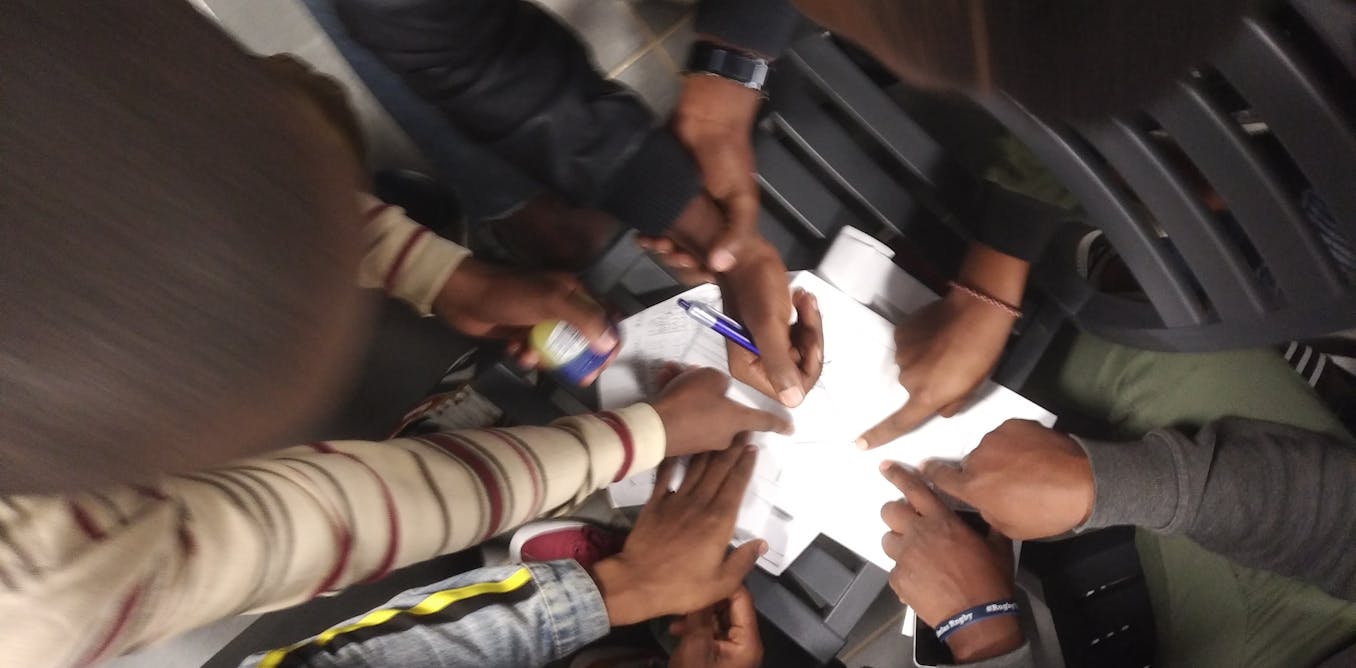
Author provided (no reuse)
Also, it’s quite easy to determine whether somebody did their own research and created their own arguments when they have to reflect on it.
When students don’t understand the text of their essay, it’s a sign that they didn’t produce it. As academics and writing coaches we increasingly encounter students who, instead of requiring help with their own essay or assignment, need assistance with their AI-produced text. Students ask questions about the meaning and relevance of the text.
Writing centre consultations have always relied on asking the students questions about their writing in an attempt to guide them on their academic exploration. But recently more time needs to be spent on reading what the students present as their writing, and then asking them what it means. Therefore, instead of specifics, we now need to take a step back and look at the bigger picture.
Not all students use generative AI poorly. That is why I still believe in using AI detection tools as a first “flag” in the process: it provides a place to start.
What interventions do you propose?
Students should be asked questions about text, like:
-
Does what it is saying make sense?
-
Does this statement sound true?
-
Does it answer the lecturer’s question?
In some instances teaching and learning is moving back to paper-based assignments, which I support. If possible, we should let students write with pens in controlled environments.
It’s also becoming more important to reignite the skill of academic reading so that students can understand what their AI assistant is producing. This points to the importance of reading for understanding, being able to question what was read, and being able to remember what one has read.
Generative AI is quite western and northern-centric. I believe we in academia have an opportunity to focus, where possible, on indigenous knowledge. Students should be encouraged to reflect on indigenous knowledge more often.
Lastly, academics should not over-rely on generative AI themselves if they don’t want their students to do so. As student enrolment numbers rise, time is becoming a rare luxury for academics, but we cannot expect students to take responsibility for their learning when we want to take shortcuts in our facilitation.
Have you changed your approach given these insights?
We have been revisiting our workshop materials to include more theory and practice on reading. Well-known strategies like the SQ3R method (to survey, question, read, recite and review a text) and the PIE approach (understanding that paragraphs Point to a main idea, support this by Illustration and Explain how and why the writer supports the main idea) are infused, along with various activities to ensure students apply some of these.
Our one-on-one consultations between students and trained, qualified academic writing experts continue to be integral.
If we as academics want to continue facilitating the learning process in students – and truly put them at the centre of education – we have to empower them to think critically and express themselves in their own voices.
The post “what we’ve learnt about how students are using AI, and how to help them” by Peet van Aardt, Coordinator: Initiative for Creative African Narratives (iCAN) & Lecturer: Academic Literacy, University of the Free State was published on 02/03/2026 by theconversation.com