
When you hear the word “dinosaur”, the first thing that might spring to mind is a hulking skeleton like Sue the T rex in Chicago’s Field Museum or Sophie the Stegosaurus at the Natural History Museum in London. Dinosaur skeletons give us striking evidence of what these ancient animals looked like, from the plates and spikes on stegosaurs like Sophie to the long-necked, airplane-sized bodies of titanosaurs.
However, despite their iconic status as museum centerpieces, skeletons are not the most common type of dinosaur fossil known. That prize goes to dinosaur footprints.
The abundance of dinosaur footprints is intuitive. Each dinosaur could only leave one skeleton – but on any single day of its life, it could make thousands of footprints. So, even if only a tiny fraction were fossilised, we could expect to see many more of them in the fossil record.
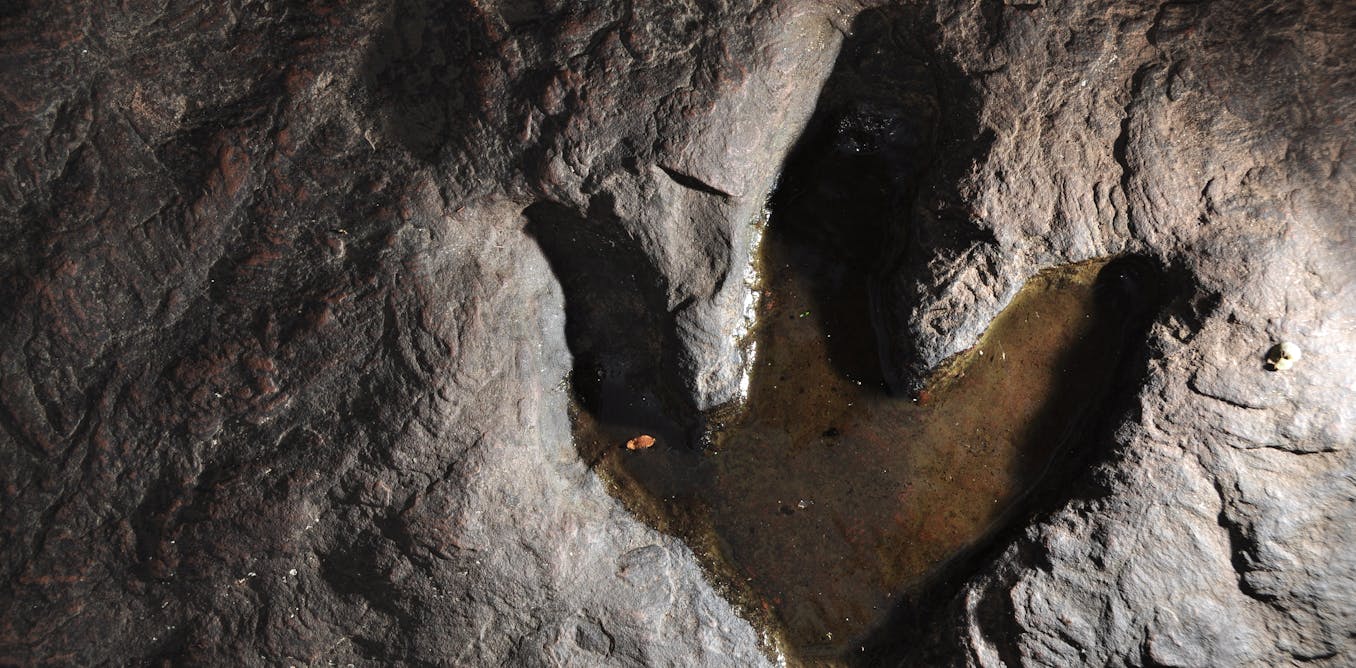
Dinosaur footprints form in environments where the ground is soft enough to leave an impression, but still cohesive enough so that the shape of the track does not collapse. We find dinosaur footprints in Mesozoic (252-66 million years old) sedimentary rocks all around the world.
Tone Blakesley, Author provided (no reuse)
Dinosaurs left their mark along coastlines in the UK, ranging from sauropod tracks on the Isle of Skye to Iguanodon tracks on the Isle of Wight. Prosauropod tracks adorn Italian mountainsides. In Bolivia, the largest dinosaur tracksite currently known consists of upwards of 16,000 theropod tracks plus a variety of swimming tracks.
Although dinosaur footprints are abundant, they are challenging fossils to study and identify. Our team, led by Gregor Hartmann at Helmholtz-Zentrum Berlin, has combined AI techniques from photon science with palaeontology in a novel attempt to address this issue.
The footprint puzzle
Dinosaur footprints are not perfect snapshots of the feet that made them. They reflect the shape of the foot, how the dinosaur was moving, and how soft or hard the ground was at the time.
Millions and millions of years of geological history have passed during which the original surface on which the dinosaur walked was buried, transformed to rock, and exposed again. Working on dinosaur footprints necessitates taking all of those factors into account when studying their shapes.
Another challenge arises when trying to determine what dinosaur made which footprints. In particular, tridactyl (three-toed) dinosaur footprints are very tricky to identify, because a wide variety of different dinosaurs have three functional toes on their hind foot. Dinosaurs as different as Megalosaurus and Iguanodon, Edmontosaurus and Albertosaurus, and Tyrannosaurus and Hadrosaurus all have three toes. These dinosaurs fall into two main groups: meat-eating theropods and plant-eating ornithopods.
When we take into account all of the different factors that contribute to the shape of a dinosaur footprint, it becomes extremely challenging to determine whether some three-toed footprints come from theropod or ornithopod dinosaurs.
An unlikely collaboration
Every fossil is a miracle. It takes the perfect combination of circumstances for a fossil to form, be preserved through millions of years, and be found and recognised by human eyes. Our collaboration arose in a similarly serendipitous way.
A physicist and data scientist, Hartmann was reading The Rise and the Fall of the Dinosaurs to his young son Julius, who was very interested in dinosaurs. As he read, Hartmann wondered if the AI methods he was using in photon science could be applied to paleontological questions. So he reached out to the book’s author, Steve Brusatte.
This led to the idea of developing an unsupervised neural network for studying dinosaur footprints. We built our training data from around 2,000 real footprints, then added millions of augmented variations to that initial dataset through strategies like displacing the edges of the footprints by a few pixels. Optimising the network took us over a year.

Tone Blakesley, Author provided (no reuse)
The key step forward for this network was its unsupervised nature. Only the outlines of the footprints were input, with no additional information about what dinosaurs might have made them. Then the network was allowed to independently discover how the different shapes varied.
This approach meant we avoided human bias in footprint identifications at the training stage. In the end, our model identified eight core axes of footprint variation, including digit spread and heel position.
When we compared the footprint groupings with expert classifications afterwards, we found 80-93% agreement overall. Thus, we could be reasonably confident the model provides a data-driven way to test the identity of particular footprints. Our findings have just been published in the scientific journal PNAS.
However, we wanted to make the network accessible to everyone, not just scientific specialists. That desire gave rise to DinoTracker, a free public app that can enable anyone to upload a picture of a dinosaur’s footprint, sketch its outline, and get instant analysis of what footprints their track is most similar to. The app can be downloaded onto a desktop from Github with the support of this installation guide.
This app certainly isn’t the end of the story when it comes to puzzling over the mysteries of dinosaur footprints. It’s a useful research resource for figuring out what tracks any footprint is most similar to in terms of shape, and what features are driving that similarity.
More excitingly, it’s a tool for curious children like Julius to take outside when they are exploring. Anyone can snap a photo, draw an outline and compare their discoveries to other dinosaur footprints.
This article includes a reference to a book included for editorial reasons, and a link to bookshop.org. If you click that link and go on to buy something from bookshop.org, The Conversation UK may earn a commission.
The post “Identifying dinosaurs from their footprints is difficult – but AI can help” by Paige dePolo, Lecturer in Vertebrate Biology, Research Centre in Evolutionary Anthropology and Palaeoecology, Liverpool John Moores University was published on 01/27/2026 by theconversation.com