
So much is deeply wrong with the world right now, but when it comes to the sphere of life that is within my own influence – my home, my heart and my place within my community – I am the happiest I have ever been.
At 37, with children aged from newborn to teenagers, as I put my apron on, cook hearty meals from scratch, wipe down our long kitchen table and pick up toys from the floor, I feel deep gratitude for my life.
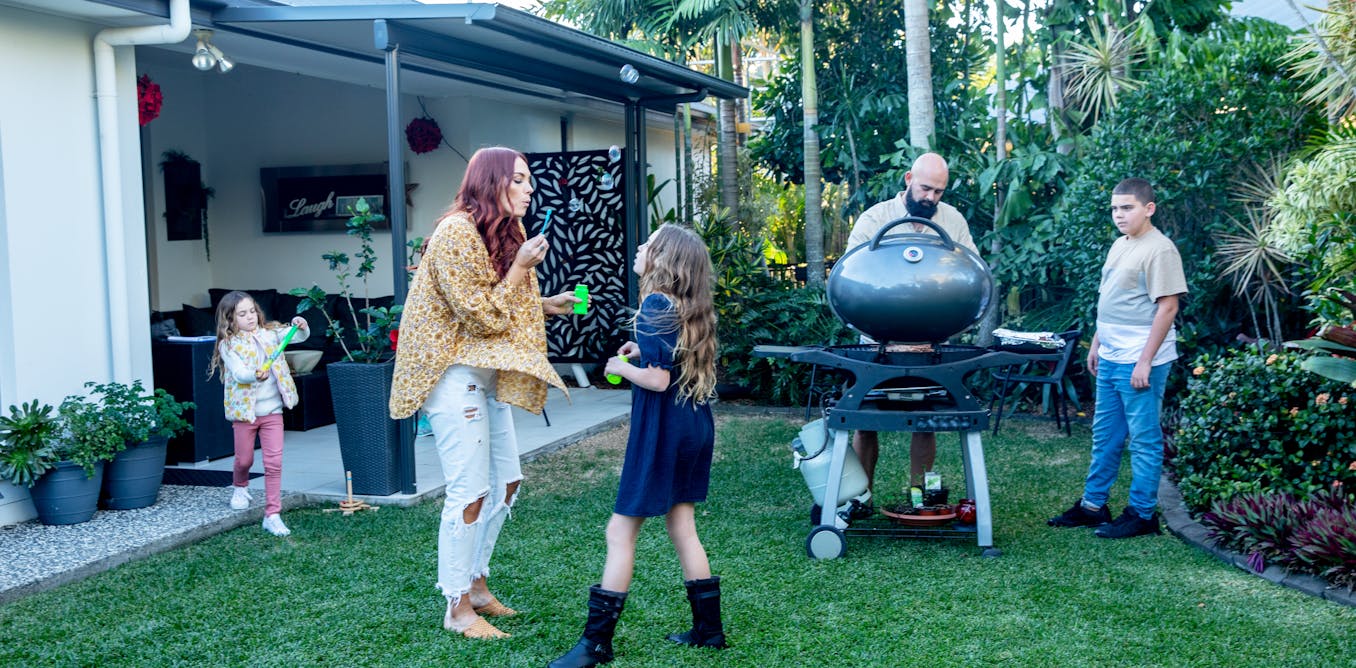
Parenting is not for everyone, but it is for me. And I love opening our home to family and community, taking herbs from our neighbours’ gardens, sharing eggs from our backyard chickens and gathering to eat meals while a collection of kids run around our home, squealing and sometimes squabbling.
I am sure for some, reading this has sent a ripple of dread through you. Have I been scooped up and put in the alt-right pipeline? Has marriage and too much time on social media converted me into a tradwife? But since when are essentially radical acts – connecting, sharing, holding space for children and being active within our communities – conservative?
Ancient practices of loving and sharing
Both colonialism and capitalism work to break down communities and reduce collectivism to individualism, with success marked by how you produce for
colonial and capitalist systems. The more isolated you are in this world, the more products you consume, the more services you need to pay for and the less empowered you feel when it comes to creating change.
Loving and sharing within your community, with your neighbours, being kind to and respecting children, creating relationships which are reciprocal, and consciously gathering with your people are ancient practices that predate capitalism and any religion you might name.
This life, this season I am in right now, is the sum of all the seasons which came before it. Connecting in real-world settings and gathering together, whether as host or as guest, requires ongoing energy and intention, and I fear that my generation and those that are coming after me are not only losing the art of gathering and the ability to function reciprocally in community, but it is being stolen from them.
Advocating, engaging in difficult work, turning up, speaking up and challenging the status quo all take bravery – but in the long term, it also takes community.
I grew up impoverished, within a criminalised family. I’ve experienced homelessness, abuse, violence, discrimination and more. The difficult circumstances of my own childhood and adolescence fill my first book, Tell Me Again (2022). And yet I have beaten the statistics and become a formally educated, well-adjusted, employed, grown person. I have three degrees, carry the title of “Dr”, and I credit much of my success to being part of my community.
I was able to grow beyond the limitations and violence I experienced as a child, because I was buoyed into bravery and action by my community. Community as an organising principle is under threat, and I believe we need to be intentional about reclaiming and rebuilding it in our lives.
Community in a cost of living crisis
The intense cost of living crisis Australians are facing has meant for many it is not possible to survive on just one job. This affects time as well as finances.
Many people cannot afford to buy their own home and so they are forced to move regularly as they’re confronted with the whims of landlords. How can you be in a community, how are you supposed to flourish and grow fruit, while being denied the opportunity to actually put down roots?
Community, in the true sense of the word, requires belonging, being known. To be in community requires more than just observation.
The rapid erosion of housing and location stability is happening at the same time as the rise in digital connection. The sting of losing community has been seemingly lessened because we can message each other across endless platforms that all live in our pockets, on phones, watches, laptops and even on the fancier fridges.

Askar Abayev/Pexels
As an autistic person who lives semi-regionally, I appreciate the ways the internet has allowed for connection. However, I also recognise that our social worlds and communities coming to “live” on these apps means that our communication and interactions are now subject to commodification, being fed through algorithms, turned into data, used to sell to us, train new technologies such as artificial intelligence, and are a tool law enforcement uses.
Do we really want to hand over community connection and our ways of being and knowing one another to tech-bro billionaires? To oligarchs?
Tools which were initially marketed as convenient and accessible have become increasingly paywalled. These digital spaces exclude many older members of our communities. They uplift both valid criticism and trolling onto a level playing field, without the weight and accountability that would accompany each in a real-world environment.
With the Australian government having just implemented a social media ban for people under 16, the youngest in our society are about to be locked out completely.
I had all of this in mind while I was spiralling over the state of politics, my role as a mother raising children in this world, the rise of fascism, the emboldening of self-proclaimed Nazis, and the ways in which my communities as an Indigenous and queer person are under constant attack.
I want to do work that matters and still rest; I want to support the work of those who are in a season of leadership, but don’t know where to start. I was feeling disempowered and exhausted.
Being a researcher and person who is soothed by a sense of action, I decided to look at what has been effective against such forces historically. The answer, put simply, is community. But finding ways to meet up was an intimidating first step.
Building community requires bravery
My family is friends with some of the busiest and most brilliant people this country has to offer, but living where we do means no one is within a 30-minute drive. To invite people over when it is not for celebration, collaboration or something more than just gathering together felt scary at first.
What if everyone said no? How embarrassing. Why should they want to come here for the evening? How intimidating. But I want my own children to be brave, I want them to take healthy risks and have good critical thinking skills, and I want them to be known by and to know these people we call friends.
We cannot physically get to every protest and my academic work will not be the most important or substantial in every season of my life, but by hosting these intentional gatherings, my children would see the machinations of community planning and action, while eating and running around with their little mates.
We’d be in a position to nourish our friends, to hear them out as they make plans. Everyone we invited said “yes”.
Several dinners over several months later and it’s brought much joy to our home. In this season we have the capacity to host, and pushing past our own tiredness and prioritising holding space, we role model for our children that community is more than just something to observe and critique; friendships
and relationships require work – that of putting on and that of showing up.
Sometimes the bravest and most important thing you can do is cook dinner and gather with the people you love. The answer to many of the world’s problems is community, and building community requires bravery.
Building your community, knowing your neighbours, regular in-person gatherings so that you can support, call in, buoy up, sustain and help one another; these are powerful tools and resources in the serious fights for human rights.
But having this realisation is what led to our family deciding and prioritising, as tired and busy as we are, to create a regular, scheduled, family-style community dinner at our home.
This is an extract of Amy Thunig-McGregor’s essay Bravery at Home, in A Time for Bravery (Australia Institute Press).
The post “in our age of AI and constant crisis, real-life community is powerful and precious” by Amy Thunig-McGregor, Research Fellow, Jumbunna Institute for Indigenous Education and Research, University of Technology Sydney was published on 01/15/2026 by theconversation.com